
This article was written by Joe Procopio and originally published on Built In.
Every startup is going to have its detractors. Every new idea, every revolutionary product, every unique strategy, and every best-made plan will find its natural enemy out in the wilds of the market.
When you’re an entrepreneur, you’re going to face armies of people who doubt you. At best, they’ll throw a cutting remark out on social media. At worst, they’ll do everything in their power — and they have a lot of power — to stop you from threatening their status quo.
Your detractor could be an incumbent company in a niche market that they’ve been taking advantage of for too long. It could be a potential customer’s “review” proxy, a tech or finance or other expert who is brought in for the sole purpose of poking holes in your solution.
The detractor I want to talk about is the “status quo hero” — an employee of a potential customer organization who has carved out an antiquated business process, made it intentionally complex and bureaucratic, and now manages an entire kingdom of inefficiency. These heroes usually lead teams of people carrying out the same costly tasks and making the same costly mistakes over and over again — because that’s how it’s always been done.
You have to kill these detractors with a combination of kindness and knowledge. You have to overwhelm them with shock and awe (kindness) and at the same time deplete their ammunition (knowledge).
This is never easy to do. Believe me, they’ve fought and won their battle many more times than you have.
But not more than me. I’ve been battling the status quo hero for a long time. Here’s what you need to know to get inside their head.
You are your detractor’s secret weapon
The first tactic a detractor will try is to get you off your game. Don’t get mad at them. Don’t complain about them. Don’t speak ill of them to anyone within their organization, even if one of their colleagues speaks up first.
I start here because I’ve seen this battle go the other way, where the founder or the sales lead was cocky, even confrontational, about the obvious necessity of their solution in the customer’s organization. You know what this does? It makes your customer think that you think that they’re stupid.
Try to close that sale.
No, after 20 years of fighting detractors, one thing I’ve learned is that logic doesn’t matter. Most people (probably you and me included) will do more work to keep things the way they are now, especially when they think their way is the right way.
If you’ve ever been in a situation where a friend of yours was struggling with a task, and you tried to help, and you maybe said something like “You’re doing it wrong,” or even “You’re trying too hard.” Well, you know how that goes over. Rarely well.
This is the bane of innovation. You can’t argue with a detractor, you have to empathize with them. You can’t tell them what they’re doing wrong, you have to get them to want to do it better. You have to win them over and become their secret weapon.
Understand your detractor by exploring the root cause
There’s one industry I’m very hesitant to do any work in, and that’s healthcare. I’ve done it before, and the industry is an entire detractor’s user group working in one building. I imagine even Band-Aids were vilified at some point.
But I ended up being an advisor for a startup in the healthcare space because the solution is so good it trumped all my negatives. This company constantly faces old-school healthcare people not wanting to use the solution and actively fighting against it.
To give you an idea of how deeply embedded the status quo is, just go to your doctor’s website right now and try to book an appointment. I bet 50 percent of you will just think, “Yeah, I know what you mean.” And another 49 percent of you will think, “What website?”
How does a status quo like that happen? The same way it happens in every industry, and I’m here to tell you it’s technology’s fault. In healthcare, in particular, it’s decades of enterprise resource planning-style software replacing paperwork. Most of the time, that software ended up being more complex than the paperwork itself, and thus it made every process take longer, procedures became bloated, and huge swaths of friction got added to every single job.
That software was sold with the same promises that innovative startups are making today: “We’re from technology, and we’re here to help.”
Now, this is a niche example from a single industry, but the prognosis (pun intended) is the same for any product in any industry.
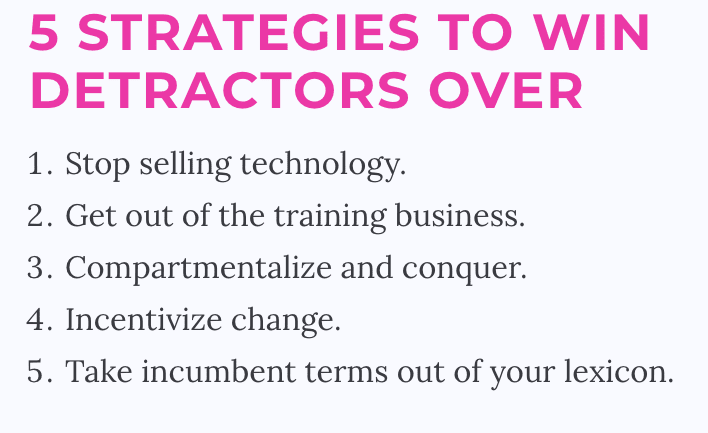
Here are five strategies I’ve developed to not only push back on detractors in a positive way, but also lay the groundwork to eventually win them over and become their secret weapon.
1. Stop selling technology
Technology can be a dirty word to some people, and again, that’s technology’s fault. You may be running the most technical company on the planet, but I assure you, you aren’t selling technology. So stop it.
What you’re selling is the benefit that the technology produces for the customer. It could be software that automates tasks, not digitizes them. It could be machine learning that eliminates the drudgery of simple decisions, not replaces human employees. Hell, it could be a carbon fiber reinforced polymer that makes a hammer easier to swing, not a damn carbon fiber reinforced polymer.
Your customers aren’t stupid. They’ll know that when you say “carbon fiber reinforced polymer” it’s because you think it’s scientific enough to go over their heads.
Technology is the primary weapon in your detractor’s fight against you. Sell benefits, not specs.
2. Get out of the training business
Any product that takes more than a couple hours to train for first use is probably bloated. No judgments here, I recently oversaw the delivery of a three-hour training session on some of our own software. In my defense, it wasn’t built for customer-facing access, because if it was, I’d have already had a walkthrough built.
Get into the walkthrough business. The less education you have to do before the customer gets results, the less ammo you’re giving the detractor in terms of the argument of removing complexity by adding more complexity.
It can also remove the complexity argument entirely. One of the products I launched with Spiffy a couple of years ago came with a three-inch by three-inch instruction sheet with four pictures and five words. It had about nine months of coding and technical development behind it.
3. Compartmentalize and conquer
The odds are that you can’t win over an entire organization at once, but if you find a champion who can translate the value of your product through the bloat of what the job has become, you have a decent shot. You’re basically fighting the detractors from the inside, which is insidious and awesome.
We did this at Automated Insights, a company that produced narrative reports like news articles from raw data. When we took our engine to the Associated Press to write their high-profile public company quarterly earnings recaps, we found an ally in a vice president in their editorial department. They championed our product’s value to journalists who thought we would be eliminating their jobs and at the same time didn’t believe our technology worked.
Yes, the double whammy. How could we replace their jobs if our tech didn’t work? Remember what I said about logic being a non-factor? This was that. When the correct information comes from the inside, it’s that much harder for detractors to stir doubt, because they’re calling out one of their own.
4. Incentivize change
A great way to beat detractors inside of your own organization is to incentivize change. This is not just handouts and kudos, it’s rethinking the way performance is measured.
We did this at Spiffy a few years ago when I launched an “instant upgrade” program to resolve problems we found on the spot. This program required our technicians to inspect each vehicle before they serviced it, which added about 10 minutes to each service. But simple math told us 10 minutes 10 times a day means one less service a tech could do in a day.
So we changed the way we incentivized their performance, tweaking quality above quantity, which led them to find an aggregated 10 other minutes during each service that weren’t necessary and eliminate that waste. Everybody won.
5. Take incumbent terms out of your lexicon
I’m advising another company that’s changing the way recruiting and hiring is performed. Their solution disrupts the process entirely, with quantifiable results. But it’s a total change in an area with a lot of detractors waiting in the wings to defend spending days on tasks that should take minutes.
To capitalize on the benefits of this new type of product and to disarm the detractors, I recommended the startup take out all references to incumbent industry terms and jargon. Those terms aren’t in the software, they aren’t in the marketing materials, they aren’t in the sales pitch.
This tactic, like all the others, resulted in an added bonus of making it clear that we weren’t the detractor’s enemy, we were their ally. We weren’t taking their jobs, or their power, or their inefficient kingdom. Instead, we were giving them better jobs, promotions, if you will, with more power in a more efficient and stronger kingdom.
Even the most hardline detractor will find it tough to argue with that.