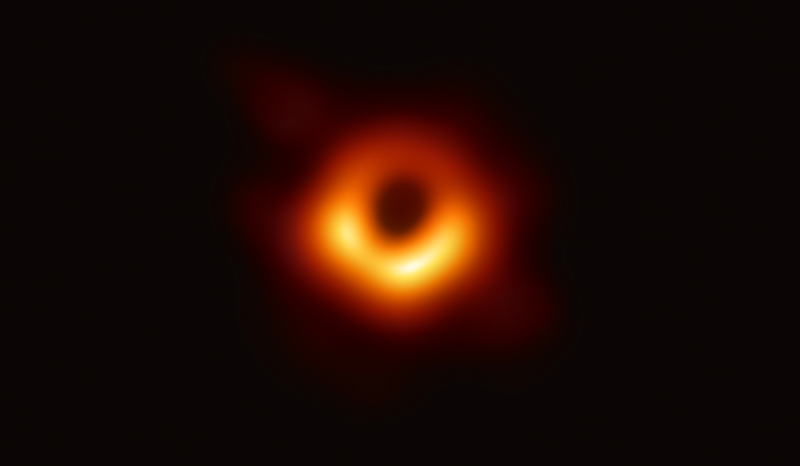
Astronomers famously snapped the first ever direct image of a black hole in 2019, thanks to material glowing in its presence. But many black holes are actually near impossible to detect. Now another team using the Hubble Space Telescope seems to have finally found something nobody has seen before: a black hole which is completely invisible. The research, which has been posted online and submitted for publication in the Astrophysical Journal, is yet to be peer-reviewed.
Black holes are what’s left after large stars die and their cores collapse. They are incredibly dense, with gravity so strong that nothing can move fast enough to escape them, including light. Astronomers are keen to study black holes because they can tell us a lot about the ways that stars die. By measuring the masses of black holes, we can learn about what was going on in stars’ final moments, when their cores were collapsing and their outer layers were being expelled.
It may seem that black holes are by definition invisible – they after all earned their name through their ability to trap light. But we can still detect them through the way they interact with other objects thanks to their strong gravity. Hundreds of small black holes have been detected by the way they interact with other stars.
There are two different approaches to such detection. In “X-ray binary stars” – in which a star and a black hole orbit a shared center while producing X-rays – a black hole’s gravitational field can pull material from its companion. The material circles the black hole, heating up by friction as it does so. The hot material glows brightly in X-ray light, making the black hole visible, before being sucked into the black hole and disappearing. You can also detect pairs of black holes as they merge together, spiraling inwards and emitting a brief flash of gravitational waves, which are ripples in spacetime.
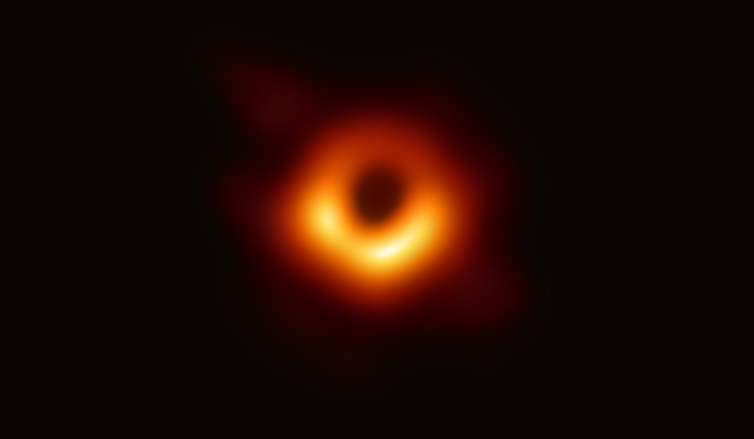
There are many rogue black holes that are drifting through space without interacting with anything, however – making them hard to detect. That’s a problem, because if we can’t detect isolated black holes, then we can’t learn about how they formed and about the deaths of the stars they came from.
New, dark horizons
To discover such an invisible black hole, the team of scientists had to combine two different types of observations over several years. This impressive achievement promises a new way of finding the previously elusive class of isolated black holes.
Einstein’s General Theory of Relativity predicted that massive objects will bend light as it travels past them. That means that any light passing very close to an invisible black hole – but not close enough to end up inside it – will be bent in a similar way to light passing through a lens. This is called gravitational lensing, and can be spotted when a foreground object aligns with a background object, bending its light. The method has already been used to study everything from clusters of galaxies to planets around other stars.
The authors of this new research combined two types of gravitational lensing observations in their search for black holes. It started with them spotting light from a distant star suddenly magnify, briefly making it appear brighter before going back to normal. They could not see any foreground object that was causing the magnification via the process of gravitational lensing, though. That suggested the object might be a lone black hole, something which had never been seen before. The problem was that it could also just have been a faint star.
Figuring out if it was a black hole or a faint star required a lot of work, and that’s where the second type of gravitational lensing observations came in. The authors repeatedly took images with Hubble for six years, measuring how far the star appeared to move as its light was deflected.
Eventually this let them calculate the mass and distance of the object which caused the lensing effect. They found it was about seven times the mass of our Sun, located about 5,000 light years away, which sounds far away but is actually relatively close. A star that size and that close should be visible to us. Since we can’t see it, they concluded it must be an isolated black hole.
Taking that many observations with an observatory like Hubble isn’t easy. The telescope is very popular and there is a lot of competition for its time. And given the difficulty of confirming an object like this, you might think the prospects for finding more of them aren’t great. Luckily, we’re at the beginning of a revolution in astronomy. This is thanks to a new generation of facilities, including the ongoing Gaia survey, and upcoming Vera Rubin Observatory and Nancy Grace Roman Space Telescope, all of which will take repeated measurements of large parts of the sky in unprecedented detail.
That’s going to be huge for all areas of astronomy. Having regular, high-precision measurements of so much of the sky will let us investigate en masse things which change on very short timescales. We’ll study things as varied as asteroids, exploding stars known as supernovas, and planets around other stars in new ways.
When it comes to the search for invisible black holes, that means rather than celebrating finding just one, we could soon be finding so many that it becomes routine. That will let us fill in the gaps in our understanding of the deaths of stars and the creation of black holes.
Ultimately, the galaxy’s invisible black holes are about to find it much harder to hide.
This article by Adam McMaster, Postgraduate Research Student (PhD) in Astronomy, The Open University and Andrew Norton, Professor of Astrophysics Education, The Open University, is republished from The Conversation under a Creative Commons license. Read the original article.