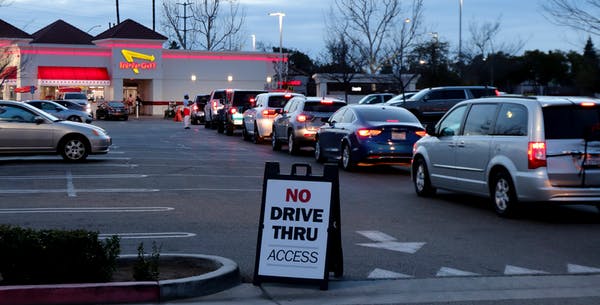
Drive-throughs – services that let people order and collect food and drink without needing to leave their cars – are designed with convenience in mind. Whether it’s oppressively hot, uncomfortably cold, or we’re just in a hurry, drive-throughs have become very appealing in an era characterised by a desire for immediacy.
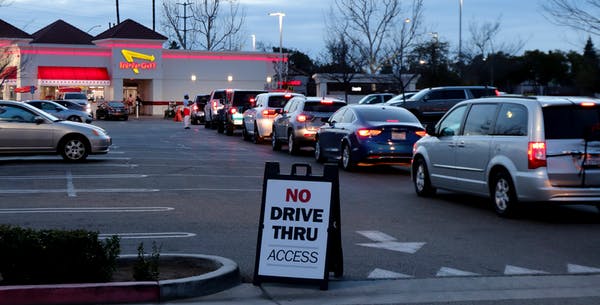
In the UK, where there are around 2,000 drive-throughs, it’s not unusual to see snaking queues of vehicles whose drivers are waiting for their turn to make, pay for, and collect their orders.
In fact, drive-throughs are on an upward trajectory in the UK. There was a 41% increase in the number of drive-throughs between 2015 and 2020, and 12% of sales at fast food restaurants and coffee chains were made through their drive-through sites in the year to March 2021: jumping 50% from pre-COVID figures.
This service has become indispensable for many. Drive-throughs provide benefits for people with mobility challenges as well as those with intensely busy schedules or people wrangling small children. In the US, even some banks and pharmacies offer drive-through options. And by helping customers avoid indoor dining, drive-throughs may have also helped limit the spread of COVID-19. But drive-throughs come at a cost.
First, drive-throughs require excessive idling, something that is banned on public roads in the UK but regularly and casually done in drive-through queues. In addition to increasing emissions, wasting fuel and damaging engines, exhaust pipe emissions associated with idling create local air pollution with serious environmental and health consequences.
Poor air quality is already a widespread problem in the UK where more than two-thirds of local authorities breach air quality targets. Even if we were to meet these targets, the Royal College of Physicians has warned that only a fraction of incidences of air quality-related illnesses – including lung cancer, asthma attacks, and overall lower life expectancy – would be prevented. Currently, air pollution leads to 40,000 deaths per year in the UK, with annual costs to the NHS of more than £20 billion.
In light of the ongoing transition towards electric vehicles, the environmental concerns of idling will diminish. The UK’s plan to phase out sales of internal combustion engines will also reduce exhaust pipe emissions as we head towards 2050.
Yet even so, emissions from brake wear and tyre wear are respectively responsible for 16-55% and 5-30% of non-exhaust emissions in UK towns and cities. That means air pollution and its associated health effects will not be completely resolved by the switch to electric cars.
The bottom line
Around the world, cities have begun to crack down on the drive-through, despite renewed investment following the pandemic. Some regions in Canada and the United States have already banned or restricted new drive-throughs, while cities such as Glasgow are beginning to consider following suit. As the UK tries to reduce car ownership and use, drive-throughs will also inevitably be discouraged.
Curbing the expansion of drive-throughs now will not severely affect UK restaurants’ revenue: especially given their relatively low market share when you consider that 70% of fast food sales in the United States are made via drive-throughs. However, the negative implications of “drive-through culture” have deeper roots.
Car-centric transport planning has dominated UK urban development since the second world war. It has increased congestion and contributed to public health problems such as the effects of poor air quality and the growing incidence of obesity, while cutting the share of trips taken via more environmentally friendly options such as public transport, cycling and walking.
Urban development that prioritises cars is also inconsistent with UK government goals to improve wellbeing, food systems and public health. Instead, building cities with wider pavements, segregated bicycle paths and widespread public transport – where we can reduce our reliance on cars and fast food – represents the healthy urban future that experts suggest we should try to create.
And for those with mobility or childcare issues, the growth of smartphone apps enabling restaurant-to-car delivery outside of drive-throughs allows people to conveniently and safely collect food without needing to queue. Food delivery apps whose riders use bicycles can also help reduce car trips while maintaining convenience.
Collectively, we need to reflect on the profoundly negative effects of living in a society that has become so pressed for time that we cannot afford to get out of our cars to collect food, let alone to eat it.
Fundamentally, drive-throughs are symptomatic of a mode of living from which we need to move away – for the sake of our planet. Limiting them in the UK would be a sign of progress not just for the environment but for our society too.
This article by Eugene Mohareb, Lecturer in Sustainable Urban Systems, University of Reading, and Sybil Derrible, Associate Professor of Urban Engineering, University of Illinois at Chicago, is republished from The Conversation under a Creative Commons license. Read the original article.