
In a laboratory at the University of Hull 50 years ago, a new chemical compound was created that would impact the world as much as any drug, fuel or material. The man responsible for this society-changing invention was George Gray – his new liquid crystal molecules (now known as 5CB) made liquid crystal displays (LCDs) viable and kickstarted the multibillion-dollar flat-screen industry.
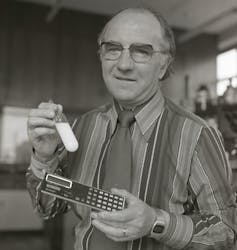
The story begins back in 1967 when John Stonehouse, a Labour MP and minster for technology under Prime Minister Harold Wilson, established a group to develop a technology that had only just made its debut on Star Trek – a full colour flat-screen display.
Unfortunately for Stonehouse, his amazing foresight has since been overshadowed by his attempt (in 1974) to fake his own death to avoid punishment for multiple counts of fraud and forgery.
But before we get back to the colorful characters involved, let’s take a look at the science of LCDs.
Pixels and light
Liquid crystals are a state of matter that sits between liquids and solids. They flow like a liquid, while the molecules within them maintain some order relative to each other, like in a crystal. The long and thin molecules pack against one another in an ordered rectangular arrangement of rows.
Crucially, these liquid crystal structures can interact with light in interesting ways, and this is key to how they work within flat-screen displays. Each pixel within an LCD is comprised of a light source, usually a light-emitting diode (LED), and a thin layer of liquid crystals sandwiched between two filters that scientists describe as polarizing.
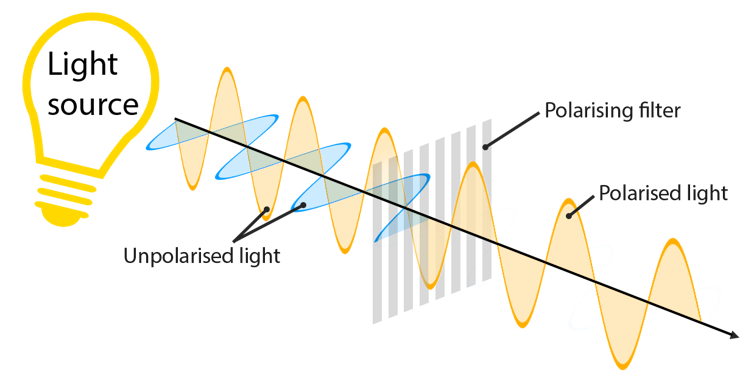
The light emanating from a bulb, LED or the Sun is known as unpolarized, in the sense that it consists of waves travelling outwards in a variety of orientations. By analogy, imagine a group of schoolchildren all waving skipping ropes. Some will wave their ropes up and down and some side to side, and some at angles in between.
Polarizing filters bring order to emanating light waves by only allowing waves with a particular orientation to pass. As well as in LCDs, you find them in some sunglasses, for example. If we return to our rope analogy, imagine the ropes are fed through a slatted gate. The parallel slats of the gate only allow the waves travelling up and down to propagate, while the waves from all the children shaking their ropes in other directions are restricted – that’s what polarization does with light.
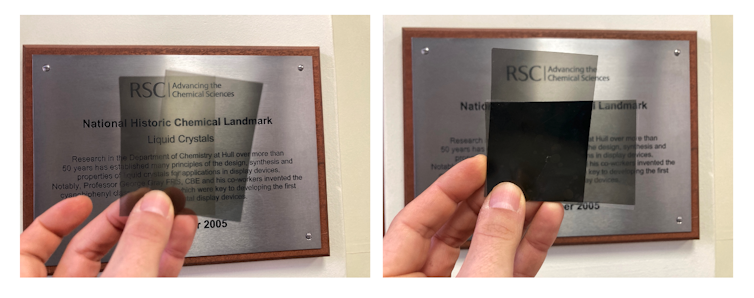
Now imagine you have two polarizing filters. You place one on top of the other and hold them up to the light. As expected, they cut out some of the light getting to your eye. Now, while keeping one in front of the other, you twist a filter by 90 degrees. It turns out that something odd happens – they now cut out all the light and together the filters appear opaque. In this orientation the first filter is cutting out the “side-to-side” polarized light, whilst the second filter cuts out “up and down” light.
At the heart of LCDs are two polarizing filters in this orientation.
And now the liquid crystal
The thin layer of liquid crystals between these polarizing filters does something rather clever. The molecules stack in the shape of a helix that twists the polarization of the light, letting it slip through the second filter.
There’s one more thing needed to turn this sandwich of polarizing filters and liquid crystals into a pixel within a display. You need some means to switch the liquid crystal’s light-twisting properties on and off. That way you can control whether a pixel is bright or dark.