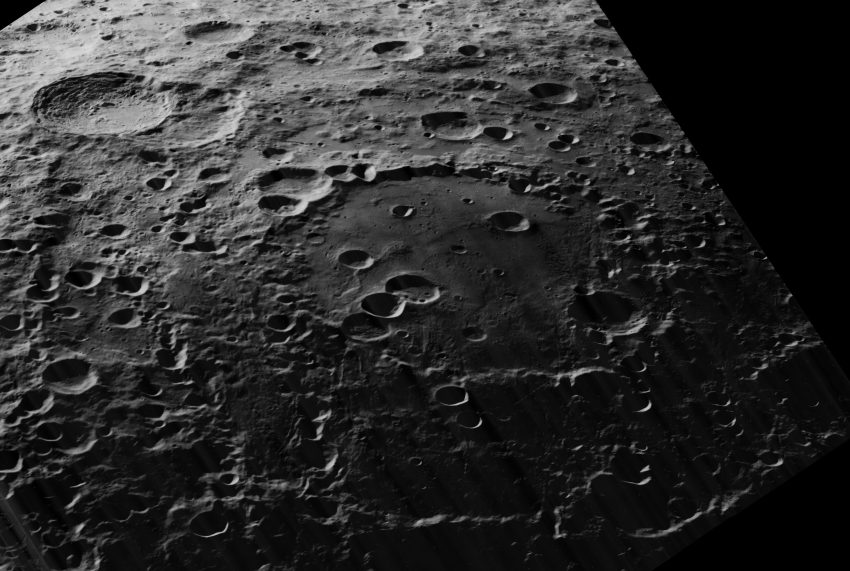
On March 4, 2022, a lonely, spent rocket booster will smack into the surface of the Moon at nearly 6,000 mph. Once the dust has settled, NASA’s Lunar Reconnaissance Orbiter will move into position to get an up-close view of the smoldering crater and hopefully shed some light on the mysterious physics of planetary impacts.
As a planetary scientist who studies the Moon, I view this unplanned impact as an exciting opportunity. The moon has been a steadfast witness to solar system history, its heavily cratered surface recording innumerable collisions over the last 4 billion years. However, scientists rarely get a glimpse of the projectiles – usually asteroids or comets – that form these craters. Without knowing the specifics of what created a crater, there is only so much scientists can learn by studying one.
The upcoming rocket impact will provide a fortuitous experiment that could reveal a lot about how natural collisions pummel and scour planetary surfaces. A deeper understanding of impact physics will go a long way in helping researchers interpret the barren landscape of the moon and also the effects impacts have on Earth and other planets.

When a rocket crashes on the Moon
There has been some debate over the exact identity of the tumbling object currently on a collision course with the Moon. Astronomers know that the object is an upper stage booster discarded from a high-altitude satellite launch. It is roughly 40 feet (12 meters) long and weighs nearly 10,000 pounds (4,500 kilograms). Evidence suggests that it is likely either a SpaceX rocket launched in 2015 or a Chinese rocket launched in 2014, but both parties have denied ownership.
An instant after the rocket touches the lunar surface, a shock wave will travel up the length of the projectile at several miles per second. Within milliseconds, the back end of the rocket hull will be obliterated with bits of metal exploding in all directions.The rocket is expected to crash into the vast barren plain within the giant Hertzsprung crater, just over the horizon on the far side of the moon from Earth.
A twin shock wave will travel downward into the powdery top layer of the Moon’s surface called the regolith. The compression of the impact will heat up the dust and rocks and generate a white-hot flash that would be visible from space if there happened to be a craft in the area at the time. A cloud of vaporized rock and metal will expand from the impact point as dust, and sand-sized particles are thrown skyward. Over the course of several minutes, the ejected material will rain back down to the surface around the now-smoldering crater. Virtually nothing will remain of the ill-fated rocket.
If you are a fan of space, you may have experienced some déjà vu reading that description – NASA performed a similar experiment in 2009 when it intentionally crashed the Lunar Crater Observation and Sensing Satellite, or LCROSS, into a permanently shadowed crater near the lunar south pole. I was a part of the LCROSS mission, and it was a smashing success. By studying the composition of the dust plume lofted into the sunlight, scientists were able to find signs of a few hundred pounds of water ice that had been liberated from the Moon’s surface by the impact. This was a crucial piece of evidence to support the idea that for billions of years, comets have been delivering water and organic compounds to the Moon when they crash on its surface.
However, because the LCROSS rocket’s crater is permanently obscured by shadows, my colleagues and I have struggled for a decade to determine the depth of this buried ice-rich layer.

Observing with the Lunar Reconnaissance Orbiter
The accidental experiment of the upcoming crash will give planetary scientists the chance to observe a very similar crater in the light of day. It will be like seeing the LCROSS crater in full detail for the first time.
Since the impact is going to occur on the far side of the Moon, it will be out of view for Earth-based telescopes. But about two weeks after the impact, NASA’s Lunar Reconnaissance Orbiter will begin to get glimpses of the crater as its orbit takes it above the impact zone. Once conditions are right, the lunar orbiter’s camera will start taking photos of the impact site with a resolution of about a 3 feet (1 meter) per pixel. Lunar orbiters from other space agencies may also train their cameras on the crater.
The shape of the crater and ejected dust and rocks will hopefully reveal how the rocket was oriented at the moment of impact. A vertical orientation will produce a more circular feature, whereas an asymmetric debris pattern might indicate more of a belly flop. Models suggest that the crater could be anywhere from around 30 to 100 feet (10 to 30 meters) in diameter and about 6 to 10 feet (2 to 3 meters) deep.
The amount of heat generated from the impact will also be valuable information. If observations can be made quickly enough, there’s a possibility the lunar orbiter’s infrared instrument will be able to detect glowing-hot material inside the crater. This could be used to calculate the total amount of heat from the impact. If the orbiter can’t get a view fast enough, high-resolution images could be used to estimate the amount of melted material in the crater and debris field.
By comparing before and after images from the orbiter’s camera and heat sensor, scientists will look for any other subtle changes to the surface. Some of these effects can extend for hundreds of times the radius of the crater.
Why this is important
Impacts and crater formation are a pervasive phenomenon in the solar system. Craters shatter and fragment planetary crusts, gradually forming the loose, granular top layer common on most airless worlds. However, the overall physics of this process are poorly understood despite how common it is.
Observing the upcoming rocket impact and resulting crater could help planetary scientists better interpret the data from the 2009 LCROSS experiment and produce better impact simulations. With a veritable phalanx of missions planned to visit the Moon in the coming years, knowledge of lunar surface properties – especially the quantity and depth of buried ice – is in high demand.
Regardless of this wayward rocket’s identity, this rare impact event will provide new insights that may prove critical to the success of future missions to the Moon and beyond.
Article by Paul Hayne, Assistant Professor of Astrophysical and Planetary Sciences, University of Colorado Boulder
This article is republished from The Conversation under a Creative Commons license. Read the original article.