The U.S.tech sector is growing 10 times faster and has wages twice as high as the rest of the economy. This industry also wins the race for high profits and stock returns.
At the same time, the tech sector’s professional, managerial and executive labor forces are overwhelmingly white and male.
It is not surprising, then, that the field is under a great deal of pressure to diversify its labor force.
As researchers who study inequality, we examined the data to go beyond the picture of diversity in the tech sector as a whole. In our most recent research, we looked at which types of tech firms increased their workforce diversity, by how much, and for which groups of people. What we found surprised us.
Our research used machine learning techniques and firm-level data on employment diversity for 6,163 tech firms employing 2,582,342 workers. We used a clustering algorithm to identify groups of firms with similar changes in diversity between 2008 and 2016.
We focused in particular on professional jobs – the programmers, engineers, and designers who are the core source of innovation in the sector. We also looked at the managers and executives responsible for human resource practices. We don’t identify specific firms because this data was originally collected by the U.S. Equal Employment Opportunity Commission, and our ability to analyze it requires strict confidentiality.
Diversity trajectories
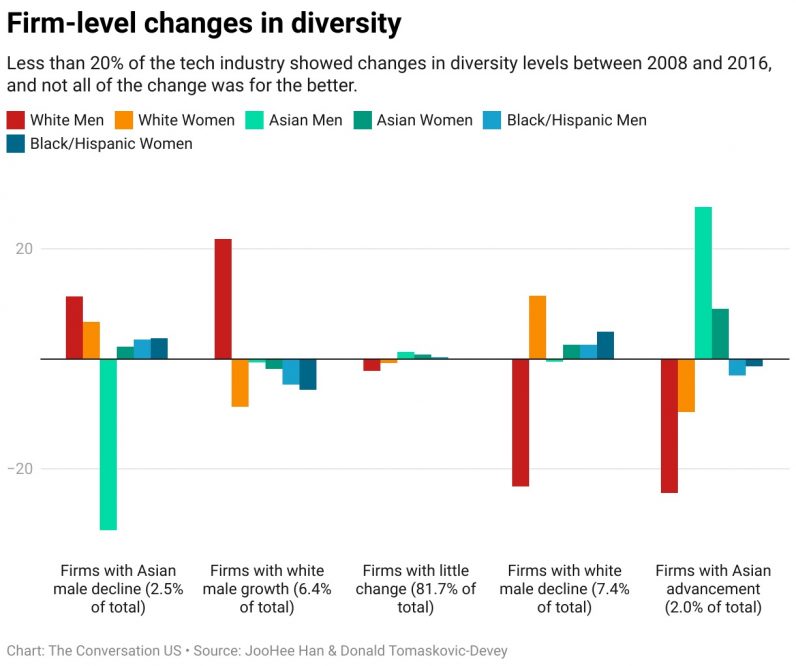
We found that 80% of firms displayed a pattern of very minimal increases in diversity in their professional labor force, primarily driven by small increases in the employment of Asian men and Asian women, with declines among non-Asian women and no change among other minority men. We also found that this widespread pattern reflects much slower movement toward employment diversity in this sector than in the rest of the U.S. labor force.
Our findings for the remaining 20% of firms surprised us. We found some firms with rapid increases in diversity among professional jobs, and others where diversity declined substantially. In about 10% of firms, we found rapid increases in the proportion of white male professionals, in most the percentage of women fell, but in some, mainly Asian men were displaced. This latter small group of firms also saw growth in all other groups, even Asian women. This pattern permitted white male dominance at the expense of Asian men while making room for all other groups.
More hopefully, we observed a rapid growth in diversity of the technical labor force in two types of firms. In both, the percentage of white men declined by about a quarter. In the larger of these two groups, about 7% of tech sector firms, white male professionals were primarily replaced with white and Asian women, although Hispanic and Black men and women saw gains as well. The second group of firms was smaller, representing only 2% of tech firms. In these, white men were replaced by Asian men and Asian women, while all other groups declined as well.
We found similar patterns at the managerial and executive levels. Most firms showed little change, but there were small groups with rapid increases in diversity, and others with rapid decreases.
White male executives declined across the sector by 5.9%, and we discovered significant increases in the representation of all other groups, even Hispanic women, in the top jobs. It appears that the most common tech response to the pressure to increase diversity was to move more women and minorities into executive positions. This pattern has been described in previous research as being primarily a defensive response to diversity demands rather than a commitment to promoting employment diversity.
When do firms become more inclusive?
We also wanted to figure out which types of firms showed a pattern of rapidly increased diversity. Here we have two more hopeful findings.
Firms where professional diversity was growing rapidly also tended to be among those with rapid overall employment growth. Diversity looks to be good for business – or perhaps innovative, well-run businesses are better at hiring more diverse labor forces.
We wondered whether increased diversity among managers who do the hiring and executives who set the tone was associated with having a rapidly diversifying professional labor force. Here we found that those firms with strong increases in managerial diversity also tended to embrace strong increases in professional diversity. In contrast, strong increases in executive diversity did not reliably raise the chances that a firm would have strong diversity growth among its core professional labor force.
Window dressing or diversity now?
It looks to us as though the recipe for increasing diversity in the tech sector is at least in part to increase diversity at the managerial level. It also looks like increased diversity is good for business, although it is also possible that well-run firms hire more diverse labor forces. Unfortunately, this combination is not widespread. Dramatic improvements in employment diversity are confined to only 10% of firms.
We believe that most of the technology industry is stuck in a low-inclusion rut, and a disturbing set of firms are moving backward. However, a handful of firms demonstrate that diversity is possible now.
This article by Donald T. Tomaskovic-Devey, Professor of Sociology and Director of the Center for Employment Equity, UMass Amherst, and JooHee Han, Postdoctoral Fellow in Sociology, University of Oslo is republished from The Conversation under a Creative Commons license. Read the original article.