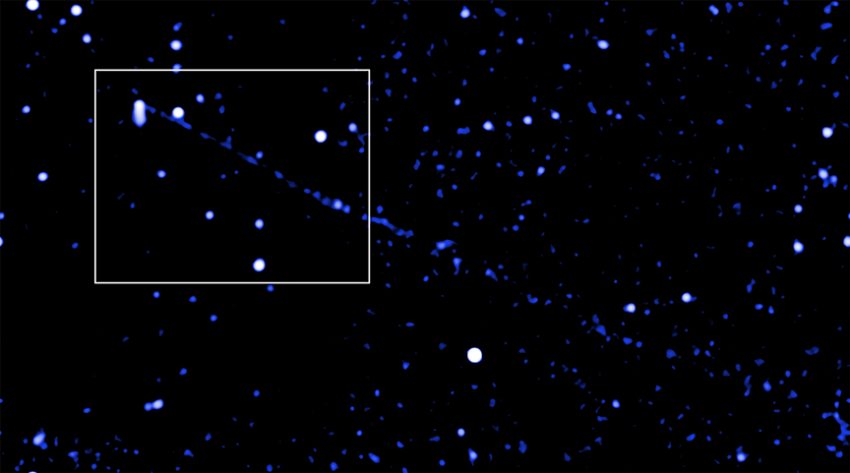
Scientists at NASA’s Chandra X-ray Observatory recently uncovered a twinkling little star that might hold the key to several of the universe’s deepest mysteries.
Called a pulsar for its twinkle, the star’s scant the size of a large city. What makes it special is, as NASA describes it, the fact that it’s apparently spewing a “gargantuan stream of matter and antimatter” into our galaxy.
Annihilation
Here’s where we run into problems. Matter and antimatter don’t get along. When, for example, a quark or a particle collides with their respective antiquark or antiparticle, a process called annihilation occurs.
As Big Think’s Ethan Siegel put it:
If there were equal amounts of matter and antimatter in the Universe, almost all of it would have annihilated away. At present, there would be less than one particle of either matter or antimatter per cubic kilometer in the Universe remaining.
As it stands, however, the Universe is much denser than that by about a factor of a billion, and practically all of what remains is matter, not antimatter.
The big mystery surrounding the origin of the universe involves trying to figure out how we got from the moments after the Big Bang, where most physicists assume matter and antimatter formed in equal amounts, to nearly 14 billion years later where 99.999+% of what exists is matter.
Due to its rarity, anything we can learn about antimatter would help scientists to understand more about the Big Bang and, perhaps, even the period preceding it.
And that’s where our little diamond in the sky comes in.
A star emerges
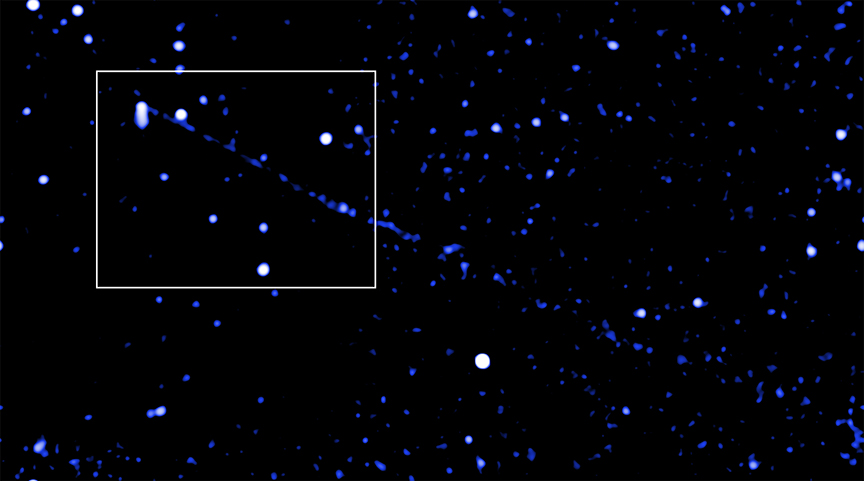
Scientists at the Chandra X-ray Observatory noticed this particular star spinning in space approximately 1,600 light years away from Earth.
Despite its diminutive stature, it stands out against the cosmic background thanks to the huge stream of matter and antimatter it’s emitting into the galaxy.
While pulsars are defined by the visible radiation they emit, that light is usually confined to its own magnetic fields. It’s incredibly rare to see that radiation leak into the universe.
But, in this case, it’s as though this little pulsar shoved a giant hose into the Milky Way’s gravitational field and started pumping it full of matter and antimatter.
Per a NASA press release, Martijn de Vries, the scientist who led the research, said:
It’s amazing that a pulsar that’s only 10 miles across can create a structure so big that we can see it from thousands of light-years away. With the same relative size, if the filament stretched from New York to Los Angeles the pulsar would be about 100 times smaller than the tiniest object visible to the naked eye.
While the universe is almost completely composed of matter, scientists on Earth have found evidence for a significant amount of antiparticles on our planet — something that doesn’t seem to add up.
The leaky pulsar NASA found may offer some insight into this mystery. According to the researchers, the pulsar’s trail only appeared in the past 30 years or so.
The scientists observed the star in a rarest-of-rare moment where it had somehow managed to burst past the “bow” of shock gas that moves ahead of it — NASA describes it as “similar to the pile-up of water in front of a moving boat” — and, for whatever reason, that caused it to start leaking through its own magnetic field.
A whale of a discovery
It feels a lot like the NASA team managed to do the cosmic equivalent of catching a blue whale spouting in the wild. Only, the researchers from the Chandra Observatory managed to do it from a distance of about 1,600 light years.
However, even from that far away, we’re still not safe from the creeping menace of antimatter. Actually, we are safe. And antimatter isn’t a creeping menace — it’s quite helpful.
Despite the fact there’s a fair chance that antimatter particles from that particular star could find their way into the Earth’s atmosphere (don’t look, but they could be standing behind you right now), they’re not going to start a chain reaction that destroys the universe.
If that was going to happen, it would have happened in the beginning when all the matter and antimatter in the universe was all in one place. Again, therein lies the mystery.
Scientists hope this information will help them to discover new insights into why antimatter seems to have a lower survival rate than matter despite it not making much sense in the standard model of the universe. And perhaps it can explain all these extra antiparticles here on Earth.
It could also help us to better understand dark matter and dark energy, matter and antimatter’s invisible cousins.
And, not to sound too optimistic, but every piece of the matter/dark matter puzzle we manage to solve brings us one step closer to the ultimate prize: the creation of an antimatter engine or, as you might recognize it, the propulsion system for Galaxy class ships in the Star Trek franchise.