
Every few decades, speakers get a little more immersive thanks to advancements in sound processing technologies and cheaper access to surround sound components.
But what if you could literally turn all the walls in your home into one giant speaker?
That might just be possible in the coming years. Researchers at MIT have developed a new type of paper-thin loudspeaker that is lightweight and durable enough to attach to all sorts of surfaces.
All that sounds neat, but fanciful technologies don’t mean much if they’re too complicated and expensive to commercialize. But this newfangled speaker promises the opposite: MIT News says the speaker-paper can be built with a three-step process that’s seemingly simpler than traditional speakers.
It’s worth noting here that this thin speaker business isn’t totally new. Planar magnetic and electrostatic drivers also rely on thin and flat vibrating material, leading to unusually slim speaker designs.
But even the material described in the MIT paper isn’t unheard of: the speakers use polyvinylidene fluoride film (PVDF), which has piezoelectric properties and has been used for speakers since at least the 70s.
Traditionally, PVDF speakers have faced numerous design challenges that prevented their commercial viability, including problematic durability and limited frequency response. They also required a sturdy supporting structure, and ultimately didn’t offer much of an advantage over traditional drivers.
MIT’s primary innovation here appears to be in reinforcing the material by reshaping it. A perforated layer of PET plastic is applied to the sheet of PVDF, which when treated with heat in a vacuum causes the PVDF to squeeze through the perforations, creating myriad tiny domes.
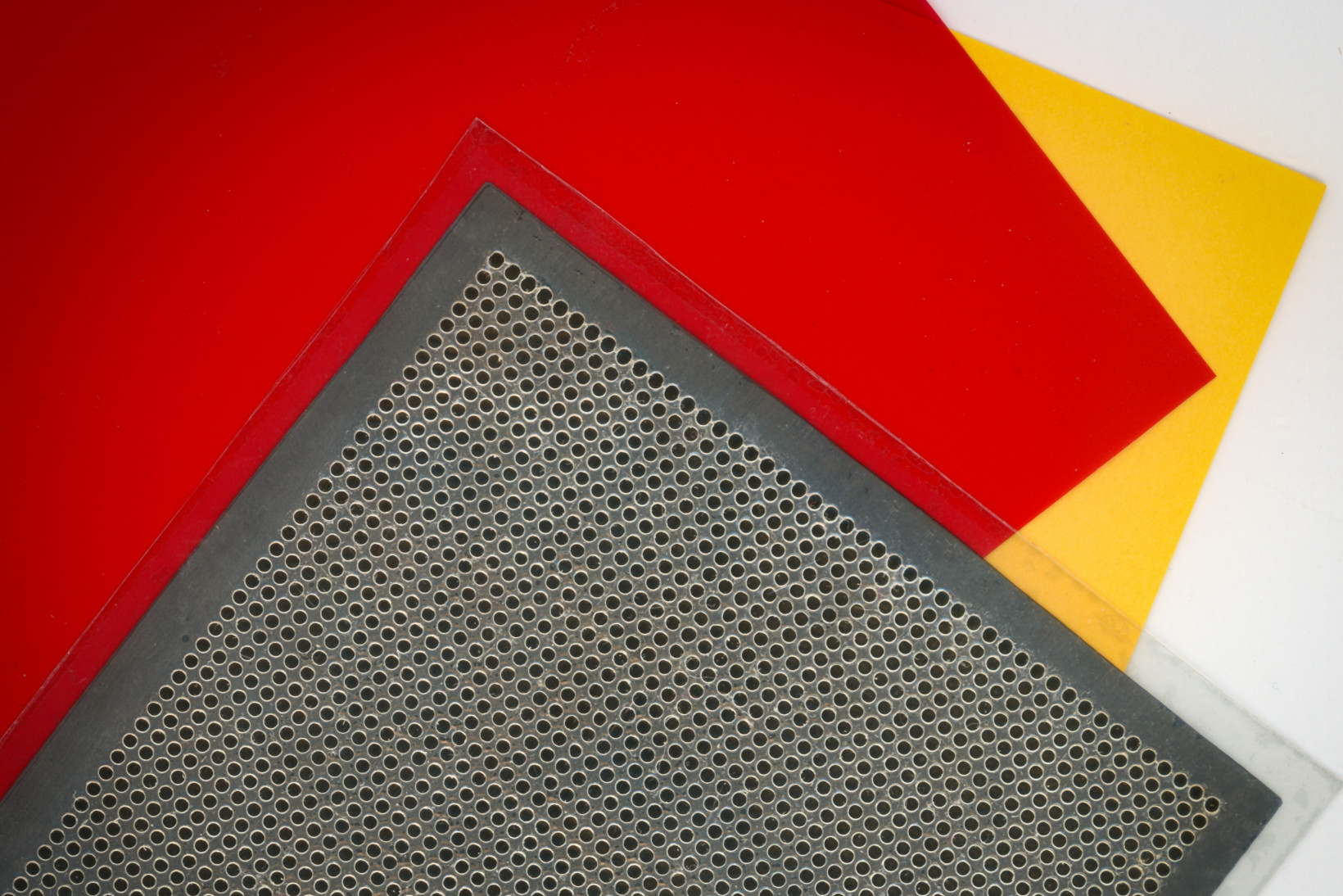
It’s kind of like super-tiny bubble wrap that can produce more than just a popping sound.
Rather than simply vibrating the entire sheet of PVDF material in unison, it’s the domes that do the vibrating. Meanwhile, the PET layers surrounding the domes add the requisite structural integrity for the material to be able to bend and be attached to surfaces without hampering sound reproduction.
Manufacturers can then tweak the acoustic properties of the material by resizing and rearranging the domes, leading to all sorts of interesting applications. The domes could be arranged to focus sound to specific locations in a room, to be used in ultrasound imaging, or even to “provide a novel method of stirring chemicals.” Sure, why not.
Circling back to this article’s lede, the weight and flexibility of the material also mean it could be used like wallpaper. Aside from the immersive implications of such a design, the ability to cover large areas and precisely shape sound means you could theoretically turn your walls into noise-canceling surfaces. functioning much like noise-canceling headphones to prevent outside noises from filtering into your home.
This idea works with regular speakers too, but limitations in positioning make it essentially impossible in any practical sense.
But enough talking — take a listen for yourself.