
When it comes to advancements for people with neurological impairments and paralysis, brain-computer interface (BCI) projects by Neuralink and the Defense Advanced Research Projects Agency (DARPA’s) Brain Initiative show huge promise, especially when it comes to mobility.
There are some huge problems though. Progress on this front is often slow, expensive, and — by and large — fails to transfer from a lab setting into the real world.
But that’s not to say that there aren’t other organizations making huge strides in BCI tech for people with paralysis.
This week saw a paper published by a German, Italian, Swiss, and American academic team looking at just that. It shared a successful research project where three participants with tetraplegic spinal-cord injuries (paralysed from the shoulders down) successfully controlled an electric wheelchair with their minds. This included navigating, steering, turning, and controlling the speed of the chair through a hospital obstacle course.
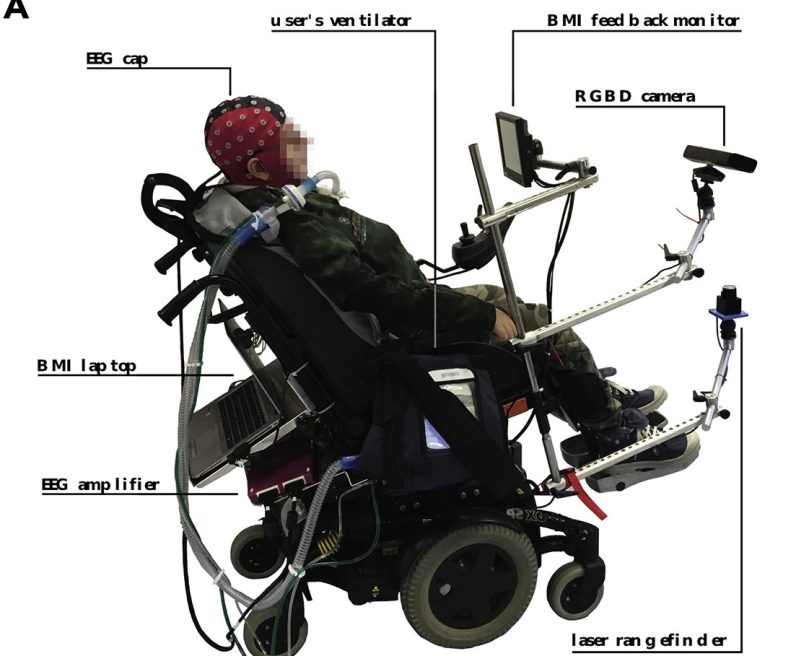
Participants wore an electrode-covered cap that recorded brain electrical activity, otherwise known as an electroencephalogram (EEG). An amplifying device sent these electrical signals to a computer that interpreted the intentions, turning them into movement.
The participants trained by visualising the wheelchair in motion, such as imagining turning a steering wheel, and expanded their capabilities over three sessions a week that took place across five months.
Why this research matters
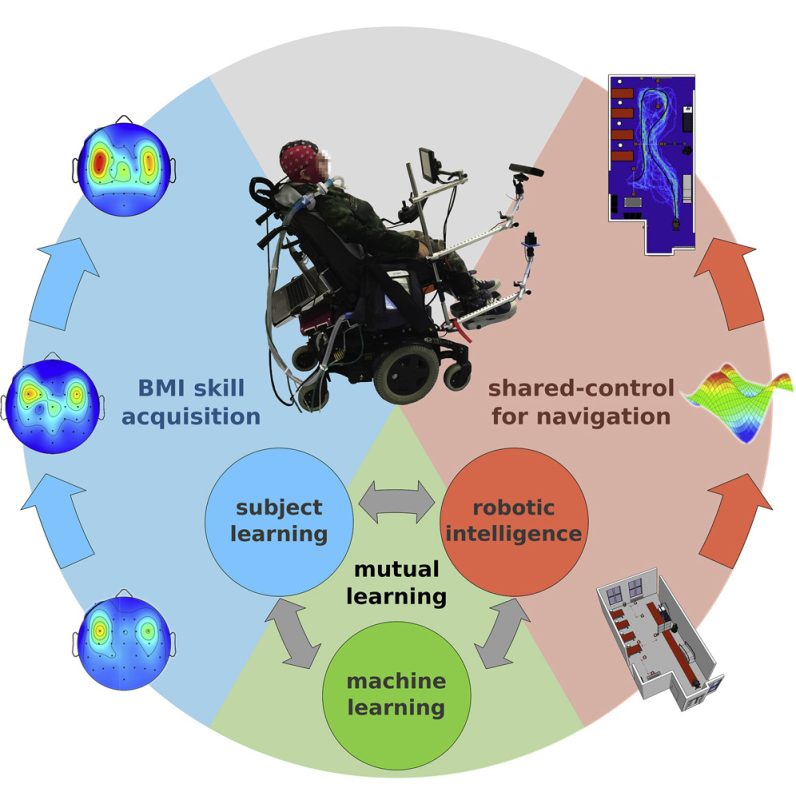
Besides being a great example of cross-institutional collaboration, the research matters for several reasons. Up to now, people have had to undergo surgical insertion of electrical implants into the motor regions of their brains for this sort of machine control.
The surgery is not only risky, but also unsuitable for many people. Furthermore, this is the only study of its kind not limited to able-bodied subjects. You read that right, most studies fail to use the people who would be the tech’s end users.
The research is also significant because it involved an intensive and long period of training where participants’ abilities could increase over time. It also offered skill development in ways that apply to a real-world setting.
At the end of the research project, two participants were able to move the wheelchairs with an impressive 95 to 98% accuracy, a boost from original scores of 43 to 55%. This result came from improvements in the computer’s ability to decode the brain activity patterns that indicate a desire to go left or right. The third participant did not improve.
And while the AI of the computer got smarter throughout the longitudinal training, the most successful participants also learnt to work with the computer. Users were able to help the computer to understand their intentions, effectively teaching it as they learned. This led to a change in their brain activity and shows potential for people who could benefit from training to control a motorised wheelchair using a brain-machine interface.
Tetraplegia is one of the most debilitating conditions around. While the study represents only a small test sample of people living with severe disabilities, it provides a precedent for future research and shows a new way forward for neurological research.