
Ever dreamed of being a Jedi? Armed with an elegant weapon for a more civilised age, many of us have fantasised about cutting a bright green (or blue) swathe across a galaxy far, far away. Disney even released a patent in 2018 for one such device, although ‘Sword device with retractable, internally illuminated blade,’ doesn’t quite evoke images of cutting through blast doors or droid armour.
That begs the question on this Star Wars Day: is it actually possible to build a lightsaber, and if so, how far away from holding it in our hands and whistling ‘Duel of Fates’ are we? The answer might surprise you —but first, we’ll have to set out exactly what we mean when we say lightsaber and learn some science on the way.
So what would you need to make a lightsaber as we know it?
There are six fundamental boxes a lightsaber must tick: it must light up and glow when in use, it must be able to cut through an object, it must be retractable, it must make a trademark whooshing noise, you must be able to cross them in a fight, and most importantly, it must obey the rule of cool. The bad news is that not all of these are possible at once — yet — but the good news is that all of them are already possible individually — at least, in theory.
Whilst we don’t have access to Kyber Crystals in our galaxy, the laws of physics make more than a fine substitute. The first problem to tackle is the light and cutting edge, and for that, we can utilise the physical principle of laminar flow. This is when all the components in a gas or fluid are moving in the exact same direction without colliding into one another, a little like when you use a shower head.
This then allows us to use any kind of fluid fuel-oxidiser mix to make a single, high-intensity beam of cutting power. Whilst we may be tempted to use a rocket-grade propellant and fuel, the reality is that something simple like the liquid propane used in BBQs is more than enough. With these ingredients; BBQ fuel, and a laminar flow jet, the task simply becomes one of tuning the fuel mix and valves to get a retractable blade. For the iconic whoosh, it’s a matter of building a circuit with a speaker and accelerometer to make the famed sound of a lightsaber when it’s swung.

The final touch is the famous colouring of the blade. While Wien’s Displacement law states that the temperature of an object is directly related to its colour, this won’t give us the intense colour we usually associate with this aspect of the Star Wars universe. Instead, by introducing small amounts of specific chemical compounds at the end of the hilt, we can influence the colour. By burning strontium metal for example, we can achieve that iconic Sith red or potassium chloride for the Mace Windu purple. The intense glow of the lightsaber will come from the heat of the plasma generated by the fuel-oxidiser mix.
This still leaves us the issue of being able to cross them in a duel, which necessitates a resistance to temperatures high enough to melt a blast door. At present, the material with the highest melting temperature is the Tantalum hafnium carbide alloy (Ta4HfC5), which melts at a whopping 3990 °C. This unfortunately is the approximate temperature of burning liquid propane. When making something retractable, you also introduce small weaknesses in a metal, which makes fractures and failures more likely. Therefore, even when working with ultra-heat-resistant materials, appropriate care is needed to keep the material from failing due to stress.
This means that any plan to build a lightsaber you can duel with needs to involve not only a heat-resistant material, but a robust one as well.
How close are we to being able to wield the favoured weapon of the Jedi?
There are two main stumbling blocks to us waving around a screen-accurate lightsaber: the fuel and the duel. Assuming that we’re still following the principle of laminar flow mentioned above, we can achieve a steel-melting, glowing beam by finding a fuel with a high density, and a high burning temperature. The former we want so we can keep the fuel in a nice little rechargeable cylinder, like a battery, and the latter so we can melt through the blast doors of any would-be rebels.
Acetylene or rocket-grade kerosene could be good candidates, with acetylene being used in plasma cutters and kerosene having put men on the moon in the Apollo programme. Yet, these still don’t quite fit the bill. Acetylene isn’t dense enough to be stored in a battery, and you would need a large tank of it to power a lightsaber for any amount of time. Kerosene on the other hand has a relatively low flame temperature, meaning it would struggle to cut through metal.
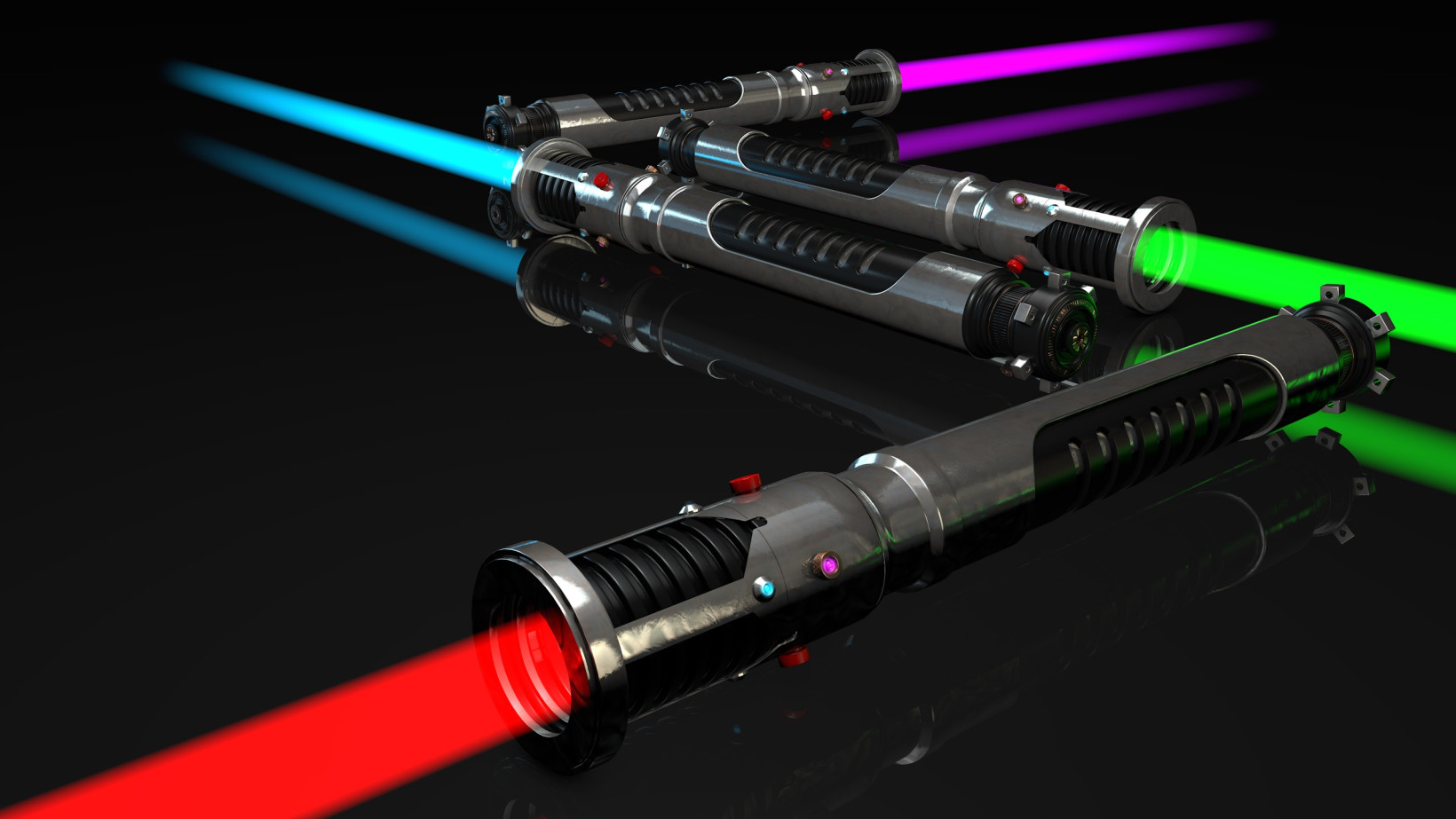
Then comes the issue of being able to cross the blade, as you need a sturdy material which can simultaneously handle the stresses of high temperature and combat with a mortal enemy. My guess for realising this design would be a central core of a high-melting-point material, like Tantalum hafnium carbide alloy, which can be telescopically extended with the high-temperature flame from the propellant and fuel mixture.
The good news is that modern science is making leaps and bounds in this area. Ongoing research into high-density, energy-rich fuels and stress-resilient materials means that we’re now closer than ever to producing a real-life lightsaber. The only question left to ask is, what colour do you want yours in?