You have probably become used to wearing a face mask in public. And you probably wear a fabric one, as we’ve been urged to save N95, FFP3, and other “clinical grade” masks for healthcare workers. This is despite science not knowing how well fabric masks work.
To overcome this, a team that I am part of at the University of Cambridge decided to test various fabrics to see how well they would protect the wearer and the public when used in face masks. One element of fabric mask efficacy can be discovered by looking at how well various materials block virus-sized particles (from 0.2 to 1.0 micrometers).
While some research had already investigated the ability of fabric to act as a filter, this previous work looked at only a small selection of fabrics and household materials, such as dish towels, scarves, and T-shirts. However, these early studies showed that fabrics could be promising as mask materials. For example, a 2013 study found that a cotton T-shirt was able to filter 69% of particles during normal breathing.
Nonetheless, these studies left those making and buying fabric masks with only limited guidance. Fabric comes in all sorts of fibers and types. Which is best for face masks? If you layer two fabrics that each filter with 40% efficacy, will this protect you from 80% of virus particles?
These studies also failed to assess a fabric’s virus-blocking ability in the types of situation where viruses are most likely to be spread, such as coughing. While a sick individual may emit some virus while breathing normally, they’re likely to expel a much higher number of particles when coughing or sneezing, where air travels at a much higher speed. If a fabric mask is to effectively protect you or others, it needs to block particles at much higher velocities than previously tested.
[Read:
Simulating coughing
So, our team devised an experiment to examine how well 20 commonly available fabrics and household materials could filter virus-sized particles at coughing speed. We designed an apparatus to hold a fabric sample that was one inch in diameter. Air was then passed through this sample at approximately 16.5 meters per second – the average speed of an adult cough as it leaves the mouth.
Two particle counters then measured the concentration of small particles in the air before and after it crossed the fabric. We then compared these concentrations to derive the filtration efficiency of the material. We did this ten times for each fabric. For the sake of comparison, an N95 mask and a surgical mask were also tested.
We also ran an additional test to see whether fabrics would show a performance drop when wet. Seven millilitres of water, about the amount exhaled in an hour, was sprayed onto some of the fabric samples. These samples were then tested five more times while wet.
While knowing the filtration efficiency of individual fabric types is useful, most fabric masks are made of at least two layers of fabric. We also wanted to know how layering fabric affects filtration. So after individual layers of fabric were tested, we then layered fabric into possible mask combinations for further testing.
Material differences
Our study showed that every mask, whether it is an N95 mask or a fabric mask, filters fewer small particles when exposed to high-speed air (coughing/sneezing) compared with normal-speed air (regularly breathing). During the high velocities of coughing, even N95 masks filtered only 53% of small particles. Surgical masks filtered less than this, about 48%.
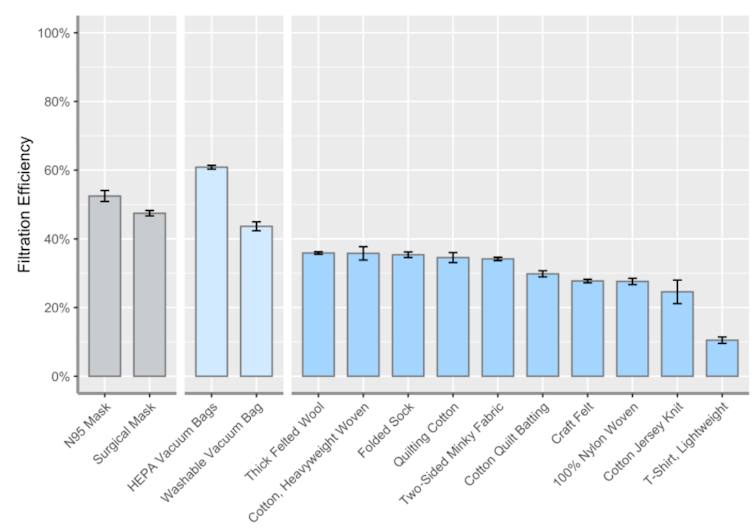
Heavy fabrics with low permeability, such as denim, provided the best protection; however, they proved difficult to breathe through and are thus not ideal for masks. Our tests indicated that more suitable fabrics included felted wool, with 36% filtration efficiency, and quilting cotton, with 35% efficiency. Fabrics that did not perform well included cotton jersey knit (25% efficiency), stretch Lycra (21%) and lightweight T-shirts (11%).
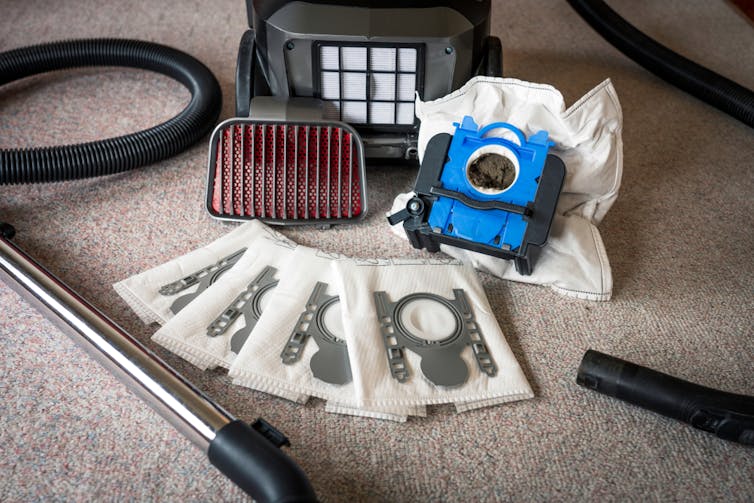
We also tested vacuum cleaner bags, which are designed to capture small particles and are readily available during the pandemic. Those we tested were highly effective at filtering particles. A disposable HEPA filter bag was 61% efficient and a washable filter bag 44% efficient. While these show tremendous promise, whether it’s safe to cover your face with these materials is not yet known.
When wet, N95 and surgical masks suffered a notable decrease in filtration efficiency – down seven and five percentage points respectively. The fabrics and vacuum bags did not show as great a decrease, and some materials even improved their performance when wet, possibly due to shrinkage of fibers or a change in electrostatic properties.
Finally, we found we achieved much higher filtration efficiencies by layering fabrics. Fusible interfacing – material primed with glue that’s stuck onto other fabrics to stiffen them, for example in collars and cuffs – proved a helpful addition. For instance, a mask with one layer of quilting cotton, one layer of thick quilt batting, and two layers of fusible interfacing was able to filter particles with about 60% efficiency. That was more than the N95 mask!
But remember: just because a fabric or combination of fabrics can filter particles well doesn’t mean it will work as well for use in a mask. The fabrics and fabric layers tended to be more difficult to breathe through than N95 mask material, and this may make a mask made from them more likely to leak and/or more difficult to fit. Furthermore, all of these percentages represent only the ability of the fabric to filter particles, and don’t take into account the effect of a mask’s fit, which is central to properly protect yourself, and others.
This article is republished from The Conversation by Eugenia O’Kelly, PhD Candidate, Department of Engineering, University of Cambridge under a Creative Commons license. Read the original article.