Ed Newton-Rex, a creative AI pioneer and VP Audio at Stability AI, says that he’s become the first author to publish a piece of classical music that uses generative AI. The musician and entrepreneur wrote his “I stand in the library,” a piece for the choir and piano, to a poem produced by OpenAI‘s generative AI model GPT3.
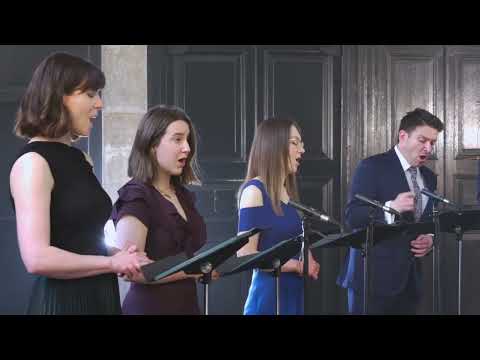
Written back in 2022, the 15-minute composition has been premiered at the Live from London online classical music festival, performed by a choral group VOCES8. The full version of the performance is available (behind paywall) on the festival’s website, but here’s an exclusive preview to give you a general idea:
All in all, he said, the poem “is not going to win any poetry competitions. But it’s not bad.”
The AI writing room
An important question about creating art with the support of AI is understanding what role it actually plays. In the case of “I stand in the library,” the GPT-generated lyrics had quite some influence on the human composer’s creative process.
“What GPT3 really did here was provide inspiration,” Newton-Rex said. “It just randomly chose to mention a piano. And because it did that, I ended up thinking, ‘well, I’ll write this piece for choir and piano,’ which I don’t usually do. Choir and piano is not a very common combination.
“But what I found super interesting is that I enjoyed that process so much that I ended up writing a bunch more choir and piano pieces, and it’s now become one of my go-to styles. And that’s interesting, because if I didn’t use GPT3 on that one particular day, and this stochastic process did not randomly output the word piano, my writing style would now be quite different.”
How do you publish AI work?
Newton-Rex has been composing choral music for many years now. Most of his work is published by UK-based sheet music publisher Boosey & Hawkes.
“It is not the biggest industry in the world, my royalty checks are very small,” he remarked with a laugh.
With the latest piece, the publisher had a hard time working out the legalities, Newton-Rex added. It was not able to get guidance from the UK’s Performing Rights Society (PRS) on registering the copyright on both the music and the text if the latter is generated by AI.
As a result, “I stand in the library” is published as an instrumental composition, meaning that the lyrics aren’t protected by copyright laws. This is not the first time AI generated music has been afforded intellectual property rights. For example, soundtrack composer AIVA (Artificial Intelligence Virtual Artist), is registered under the France and Luxembourg authors’ right society (SACEM).
“I would guess that it’s not ideal for a music publisher to not be able to protect the text,” Newton-Rex said. “I suspect that actually wouldn’t be something that could really scale, which may be good for human creators.”
Although working with AI on his day job at Stability AI, Newton-Rex doesn’t consider changing his creative process for now.
“It’s much more of an artistic experiment and artistic statement than it is a question of [large language models] replacing poets,” he said. “It’s not like I’m going to use GPT for all of my texts — I’m going back to normal poetry.”
There’s definitely a role for AI to play in creative endeavours, as it adds random (or pseudo-random) inputs to spark human creativity.
“AI can get us out of creative loops, it can just give us new ideas,” Newton-Rex said. “It’s like being in a writing room with someone.”
The AI’s poem
If you’re curious about the text generated by AI for the choral piece, here it is in full:
I
I stand in the library
where a voice soars,
and I am taken back
to my childhood,
to the days when I first
heard the sound of the piano.
I was too young
to understand the meaning
of the words I was singing.
Yet the sound of the music
was in me, and I was moved
by the purity of that sound.
II
As I was borne along by the music, a solitary tear ran down my cheek. I did not understand why I was crying. I did not know that the voice I heard was my own.