
Like many of us, Alisha Fredriksson is terrified about climate change. But unlike many of us, she’s rolling up her sleeves and doing something about it.
Two years ago the young entrepreneur co-founded Seabound — a London-based startup on a mission to decarbonise the shipping industry.
Unlike other modes of transport like cars or buses, big shipping companies have few technologies at their disposal to slash emissions. The sector emits 3% of global carbon dioxide — more than air travel — so urgent solutions are needed.
Seabound’s answer? A carbon capture system that can remove 95% of a cargo ship’s CO2 emissions before they enter the atmosphere.

Late last year, Seabound installed a prototype of its device on a huge cargo vessel owned by British shipping giant Lomar. The pilot was funded by a £1.2mn grant under the UK government’s £60mn Clean Maritime Demonstration Competition.
Over the course of two months on a route between Turkey and the Persian Gulf, the device captured 78% of carbon emissions and 90% of sulphur dioxide from one of the ship’s auxiliary engines.
“While still early days, our first pilot project proves that our technology works and that it is possible to take on this huge, complex problem,” Fredriksson tells TNW. “This breakthrough demonstrates that the shipping industry doesn’t have to wait for new fuels or solutions to reduce its emissions in the future — we can start to capture carbon from the existing fleet right now.”
How does it work?
Seabound’s carbon capture equipment traps the exhaust gas produced by a cargo ship’s huge diesel engines. Instead of going into the atmosphere, the fumes get funnelled into a big, high-pressure chamber filled with calcium oxide pebbles.
The CO2 in the exhaust gas reacts with the pebbles and transforms into calcium carbonate — also called limestone. This limestone is then stored aboard the ship to be unloaded at dock.
Once on land, the limestone can be used as a building material or broken down to make new pebbles and pure CO2. This carbon dioxide can be buried underground or sold to companies to produce electrofuels. These are a class of synthetic fuels including green ammonia and methanol, that could, in turn, be used to power ships.
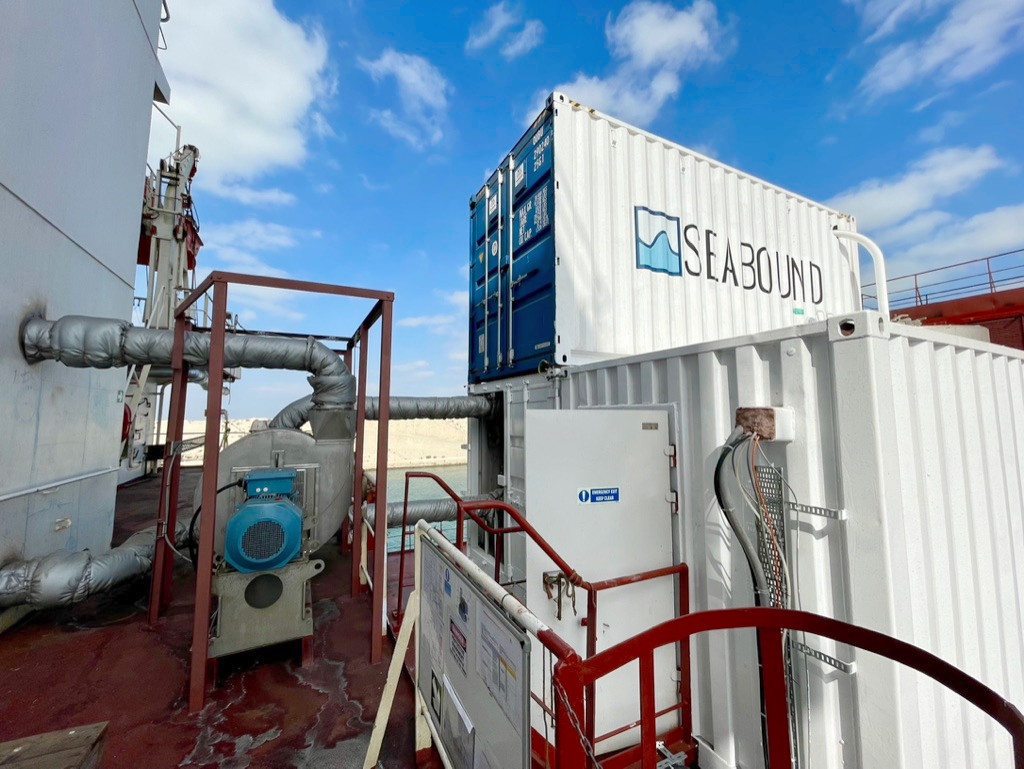
Seabound would make money by selling its hardware to shipping companies as well as charging a service cost to process the pebbles.
Following the successful completion of its pilot project, the company says it will now build a “bigger and better” system capable of removing up to 95% of the CO2 — a figure it has achieved during testing but not yet in a real-world setting.
A full-scale device capable of capturing the fumes of an entire cargo ship would measure about 6 metres by 3 metres — minuscule in comparison to the gargantuan vessels, some of which are longer than the Empire State Building is high.
Shipping’s carbon conundrum
The global shipping industry is responsible for transporting about 90% of the world’s goods. Most of the 50,000 or so cargo ships in operation today run on diesel which creates a lot of CO2. If the shipping sector were a country, it would be the world’s sixth largest emitter — one place above Germany and just below Japan.
Large ocean-going ships also tend to use bunker fuel, a low-grade, tar-like form of oil that can contain 3,500 times more toxic sulphur than the diesel used for cars.
The problem is that zero-carbon technologies that can be applied at scale to cargo ships do not yet exist.
Current battery technology simply cannot provide enormous cargo vessels with enough power to cover long distances. Nuclear propulsion has also been considered, but there are associated risks and the idea remains controversial.
The best bet are alternative, zero-emissions fuels, such as hydrogen and ammonia. But these are still in the early stages of development and require the building of entirely new ships which is expected to cost over a trillion dollars.
The UN’s International Maritime Organisation member states agreed last year for shipping to be net-zero by 2050, with a 20-30% reduction in emissions by 2030.
Frediksson believes urgent action is needed to meet such targets. “Alternative fuels for ships are at least 10 to 20 years away, but we need to start decarbonising today,” she says.
Chartering a greener course
There’s definitely merit to the startup’s plans, but challenges remain. The calcium oxide pebbles that the device relies on — also known as quicklime — are made by burning limestone at high temperatures, a process that produces CO2. And while the pebbles are relatively cheap and in plentiful supply, finding markets for the pure CO2 byproduct once it gets unloaded back on land may prove difficult.
One opportunity Fredriksson envisions is to create a circular value chain whereby the pure CO2 is turned into methane or ammonia for powering ships, the emissions of which get recaptured in the pebbles and then used to make more of these green fuels.
The carbon capture systems could also be used in conjunction with other clean shipping technologies like giant kites or WindWings that drag a ship along, reducing fuel use.
While still in the nascent stages of development, Frediksson and her team have high hopes. Seabound’s ultimate goal is to capture CO2 on 1,000 cargo ships by 2030, scaling to 10,000 cargo ships by 2040.
So far, the company has secured $4.4mn in seed funding, including backing from Lomarlabs, the venture arm of Lomar Shipping. Frediksson says she aims to close a Series A funding round this year, which the company will use to bring its first device to market in 2025.