
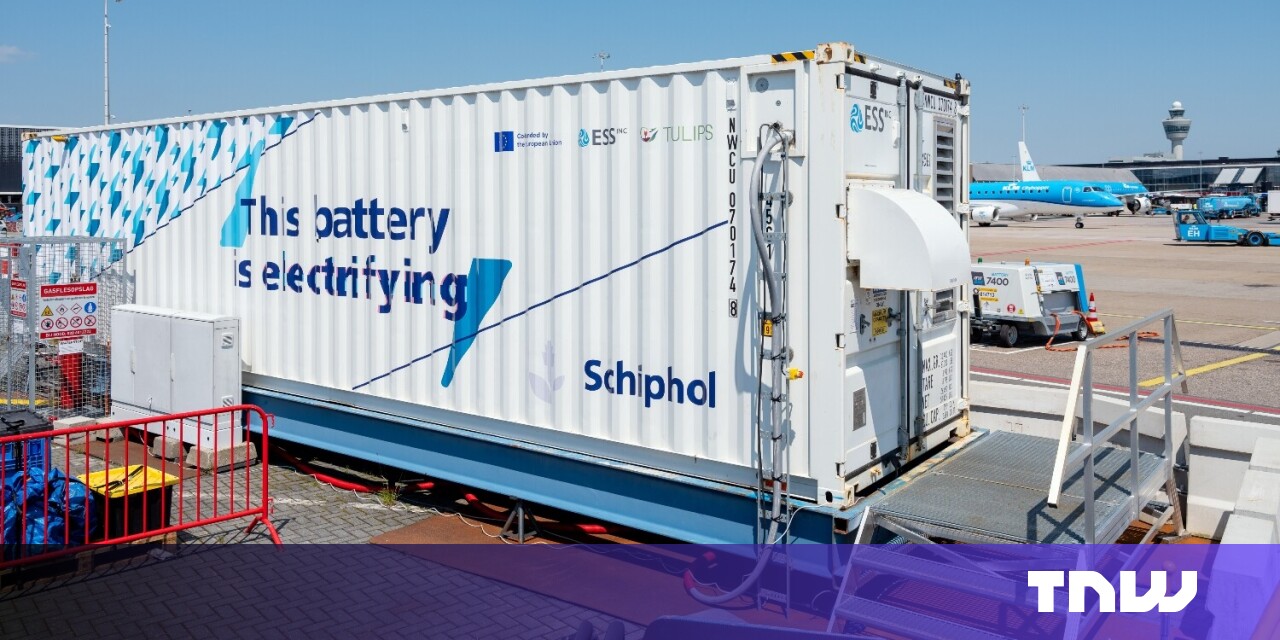
Schiphol Airport in the Netherlands is testing an unusual kind of battery that could prove to be a better, cheaper way to store wind and solar energy.
Developed by US startup ESS, the device is known as an iron flow battery. The airport is currently trialling the technology to power some of its electric ground power units. These machines provide electricity to parked planes to run systems such as lights, avionics, and air conditioning.
But why is Schiphol betting on this lesser-known type of energy storage instead of mature lithium-ion batteries? The answer can be traced back over four decades to a lab in Cleveland, Ohio.
Dusting off an old idea
Researchers at Case Western Reserve University developed the first iron flow battery in the early 1980s. But the idea remained confined to the shelves of academia. At a time when oil was cheap, developing long-duration energy storage wasn’t a top priority.
However, when chemical engineers Craig Evans and Julia Song stumbled across the Case Western research 30 years later, the energy landscape looked very different. Massive wind and solar plants were coming online. For the first time, electricity supplies became, to some extent, dependent on the highly unpredictable patterns of the wind and the sun.
Evans and Song, a married couple, saw the potential of developing a cheap form of energy storage to provide backup power when the wind isn’t blowing and the sun isn’t shining. That’s when they decided to run headlong into iron flow batteries, founding ESS in 2011 to bring the technology to market.
Today, ESS is the only company developing this type of battery on a commercial scale. The company is backed by the likes of Bill Gates’Breakthrough Energy Ventures and Softbank. In 2021, it became the first long duration energy storage company to go public when it listed on the New York stock exchange.
How does the iron flow battery work?
ESS’s iron flow battery uses two liquid electrolytes made from iron salts dissolved in water. Two separate tanks store the electrolytes. The larger the battery, the bigger the tanks. However most of the units ESS is developing fit into a standard shipping container.
These electrolytes are pumped through a central electrochemical cell where the redox reaction occurs. When the battery charges, it uses electrical energy to oxidise iron ions in one electrolyte and reduce them in the other. During discharging, the process reverses. It turns the stored chemical energy back into electrical energy.
Unlike lithium-ion batteries, iron flow batteries can be topped up with fresh electrolyte. This means they can essentially go on forever. What’s more, they use materials that are cheap, abundant, and non-toxic: iron, salt, and water. They also don’t pose a fire risk.
The trade-off is that iron flow batteries can’t store as much energy as a lithium-ion battery of the same weight — so to achieve the same efficiency they come in a bigger size.
This makes iron flow batteries more suitable for long-duration energy storage for large-scale applications, where space isn’t an issue. You definitely won’t be getting an iron flow battery in your phone or laptop anytime soon.
An airport’s bet on iron flow batteries
Lithium-ion batteries have long dominated the energy storage game. But the need to store energy for longer — and concerns over the supply and sustainability of the rare metals they rely upon — has paved the way for new alternatives. This includes everything from systems that turn hills into batteries to machines that drop giant weights down mineshafts.
The safe and sustainable characteristics of iron flow batteries were the main reason Schiphol took an early bet on this lesser-known form of energy storage, the airport said. And unlike other solutions, like pumped hydro plants, the batteries are modular and easy to deploy pretty much anywhere.
The trial at Schiphol is partly subsidised by TULIPS — a EU-funded programme aimed at accelerating the use of innovative and sustainable technologies to reduce emissions at airports.
“If the result is successful, more batteries will follow, with the aim of making all ground equipment emission-free and electric,” said Sybren Hahn, Schiphol Airport’s executive director of infrastructure.
But airports are far from the only industries interested in ESS’s batteries.
The bulk of demand for iron flow batteries comes, perhaps predictably, from energy-intensive industries. The company has already installed its battery at a solar farm and a water treatment works in California and at a power plant in Oregon.
ESS has orders for hundreds more of its iron flow batteries. Customers include SB Energy, a clean-energy subsidiary of SoftBank, which agreed to buy 2GWh of battery storage from ESS over the next four years — a deal valued at more than $300mn.
When it comes to safely storing large amounts of energy for long periods, iron flow batteries are hard to beat. And that’s exactly what grid operators will need to do a lot more of in the coming years.