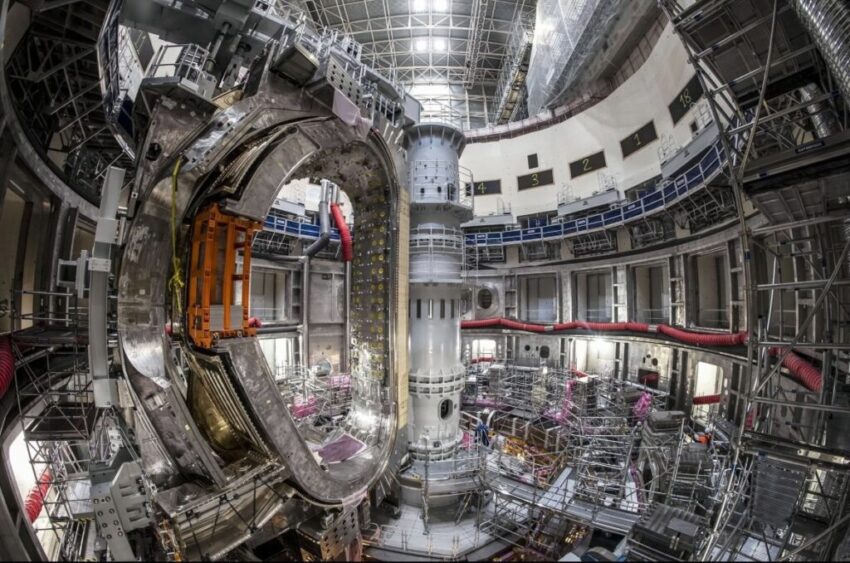
ITER — which is set to become the world’s biggest fusion reactor, and one of history’s most expensive science experiments — has reached a key milestone on its mission to create a mini Sun on Earth. But despite the apparent progress, the megaproject has also been hit by yet more delays and surging costs.
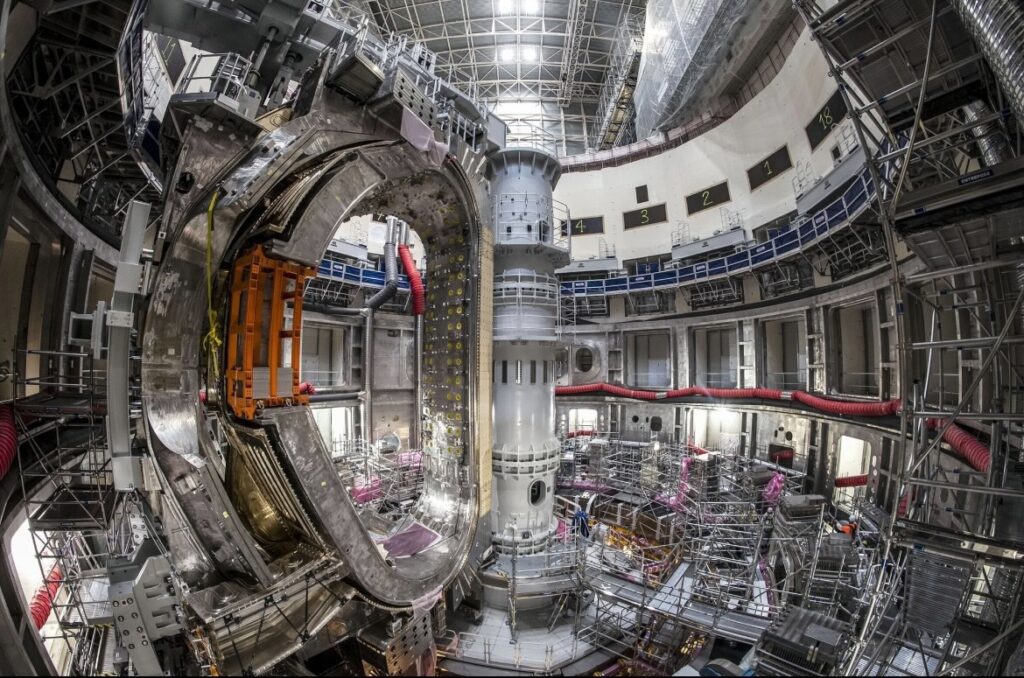
Nineteen giant magnetic coils — each measuring 17 metres tall and weighing 360 tonnes — have finally been delivered to southern France, where ITER is being constructed.
The magnets will form a cage around a donut-shaped chamber called a tokamak. Here they will create a magnetic field that confines super hot plasma, keeping it stable for long enough for a fusion reaction to occur. The magnets, which are super-cooled to –269°C, also keep the whole machine from melting under the extreme temperatures of the plasma, which can reach up to 10 times hotter than the Sun’s core.
“The delivery of these magnets is a momentous occasion that will allow ITER to reach its objectives,” said the project’s director general, Pietro Barabaschi, during a press conference yesterday.
Yet, Barabaschi also announced that the megaproject will only switch on in 2034, and start producing energy in 2039. That’s almost a decade later than originally planned, and a four-year delay from the most recent timeline, announced in 2016.
What’s more, the price tag, already estimated at €20bn, will rise by €5bn. The extra time and money will allow ITER to commission a machine capable of “full magnetic energy and current” rather than a “relatively ‘naked’ machine” — which would be the case if the project stuck to its 2016 target, said Barabaschi.
Barabaschi has largely blamed the COVID-19 pandemic for the most recent delay. However, manufacturing issues, such as the discovery of cracks in the water pipes that cool the thermal shields, have also slowed progress.
However, the reality is that harnessing fusion energy is, simply put, really bloody difficult. Even harder perhaps than scientists first predicted.
ITER risks falling behind
ITER was first conceived in 1985 and launched in 2006 by a coalition of 35 countries and regions including the EU, United States, Russia, China, India, Japan, and South Korea. Back then, it had a budget of €5bn, with the EU providing the bulk of the funding.
The reactor was designed to be an experiment, not a commercially viable reactor. Its overall aim is to produce 500 MW of fusion power for extended periods, proving that it’s possible to sustain fusion reactions for a long enough period to produce electricity.
But with dozens of private companies now developing their own commercial fusion machines, there’s a risk that ITER may become obsolete by the time it eventually powers up. Boosted by a surge of private capital and unconstrained by geopolitics, startups like Tokamak Energy, First Light Fusion, Marvel Fusion and Proxima Fusion may leapfrog to the finish line.
The ultimate goal for these companies, most of which aim to have a reactor ready by the early 2030s, is to create fusion reactions that burn hot enough and last long enough to produce a steady flow of electricity. That’s something that has never been done before.
Nevertheless, with the promise of virtually limitless, clean, reliable energy, taking a crack at building a little star on Earth is probably worth the effort — even if we have to wait around for a while to see the efforts bear fruit.