
Europe is set to regain independent access to space tomorrow, July 9, when the long-awaited Ariane 6 rocket lifts off for the first time.
The heavy-lift satellite launcher — commissioned by the European Space Agency (ESA) and made by ArianeGroup — was supposed to replace its predecessor, Ariane 5, right after its retirement a year ago.
But a series of delays in developing Ariane 6, problems with the Vega-C small-lift launcher, and the loss of access to Russia’s Soyuz rockets following the full-scale invasion of Ukraine, left Europe with no launch system of its own. As a result, for the past year, ESA has been relying on US-based SpaceX to send satellites into orbit.
Now, Ariane 6 promises to resolve what EU Commissioner for Internal Market Thierry Bretton previously called an “unprecedented” space crisis for the continent.

The <3 of EU tech
The latest rumblings from the EU tech scene, a story from our wise ol’ founder Boris, and some questionable AI art. It’s free, every week, in your inbox. Sign up now!
Standing over 60 metres tall, the rocket will weigh nearly 900 tonnes when fully loaded. This is about the same weight as one and a half Airbus A380 passenger aircraft.
It’s able to launch both heavy and light payloads for a wide range of applications, from Earth observation and telecommunications to meteorology, science, and navigation.
The rocket consists of three main parts: the main stage, comprising two detachable boosters and a Vulcain 2.1 engine; the upper stage, which houses the payload and is powered by a reignitable Vinci engine; and the fairing, which protects the satellites during the ascent.
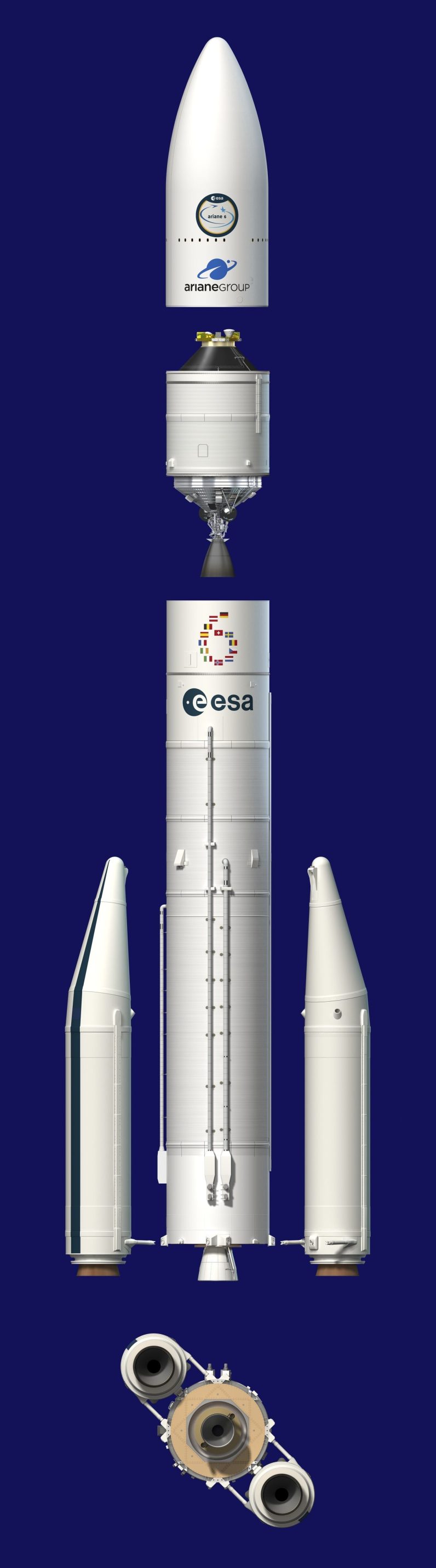
Ariane 6: Ready for lift-off
Ariane 6 will take off powered by the two boosters and the Vulcain 2.1 engine. After burning their fuel, the boosters will separate first from the rocket. Once past the Earth’s atmosphere, the fairing will also separate.
About eight minutes into flight, the entire main stage will separate. Ariane 6’s upper stage will then take over, with the Vinci engine propelling the rocket into an elliptical orbit 700km above Earth.
During the next phase, Vinci will reignite to place Ariane 6 into a circular orbit 580km from the Earth’s surface. After the reignition, the launcher will deploy eight different satellites and activate four onboard experiments.
In the final phase, the Vinci engine will reignite once again to initiate Ariane 6’s controlled deorbiting through the atmosphere over the NEMO point in the South Pacific. Two reentry capsules onboard will separate from the upper stage to make their descent.
Meanwhile, ESA will send a final command to passivate the upper stage (meaning, to remove any energy onboard) before it burns up in the atmosphere. This way, the agency aims to prevent the rocket part from lingering as space debris.
Ariane 6 will take off from the European spaceport in French Guiana. The launch window is set between 15:00-19:00 local time (20:00-00:00 CEST). You can watch the launch live on ESAWebTV or on ESA’s channel on YouTube.