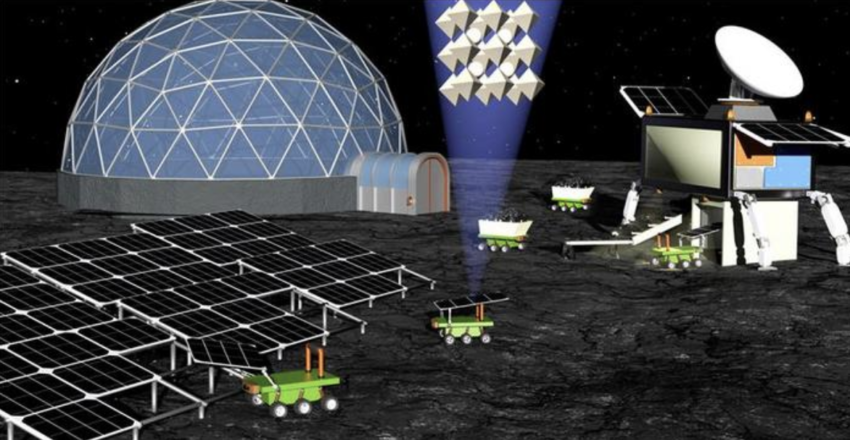
Future lunar bases could run on solar panels forged from molten moon dust, turning the Moon’s surface into an energy source, thanks to a new research breakthrough.
Scientists at the University of Potsdam have engineered so-called “moonglass” solar cells made by melting artificial moon dust or “regolith” and then combining it with a layer of perovskite crystal to create a working solar panel.
The device could be lighter, cheaper, and more radiation-resistant than the panels already used in space, said the researchers. Their results were published in the journal Device this week.
Today, solar panels power satellites, space stations, and Mars and lunar rovers. All these arrays are currently built on Earth and launched into space. But as humanity pushes for a permanent lunar presence, the need for solar power is set to skyrocket — and so will the cost of getting panels there.
Felix Lang, lead author of the paper, said that while the silicon-based solar cells used in space now are “amazing” — reaching efficiencies of 30% to 40% — they are very expensive. They are also heavy because they use glass or a thick foil as a cover. “It’s hard to justify lifting all these cells into space,” he said.
Harnessing the Moon’s own regolith could be a game-changer. By creating moonglass directly on the lunar surface and pairing it with a thin layer of perovskite crystals brought from Earth, the researchers found they could slash launch mass by 99%.
Building solar panels on the Moon

Once the materials are collected, turning them into solar panels on the Moon would require “minimal equipment,” according to the researchers, because they can be made with raw regolith that doesn’t need to be pre-processed. The team says they have already achieved promising results by using a large curved mirror and sunlight to focus a beam hot enough to melt regolith into moonglass.
Since moonglass is made from raw regolith, it’s milky-white instead of transparent, limiting its light-harvesting potential. The best prototypes from the Potsdam team reached about 12% efficiency — roughly half that of conventional perovskite cells. But simulations suggest they could eventually match the efficiency of conventional perovskite cells.
Nicholas Bennett at the University of Technology Sydney told New Scientist that this is the first successful use of moonglass in a functioning solar cell. The real challenge now, he says, is producing large quantities of the stuff outside of the lab.
Moonglass panels are the latest in a string of high-tech bids to lay the foundations for a permanent human presence on the Moon. Other planned projects include using moon dust to 3D-print a lunar base, building oxygen extraction systems from regolith, and even building space mirrors that melt the Moon’s ice into drinking water.
Space age technologies will be appearing on Earth during TNW Conference, which takes place on June 19-20 in Amsterdam. Tickets for the event are now on sale. Use the code TNWXMEDIA2025 at the check-out to get 30% off the price tag.