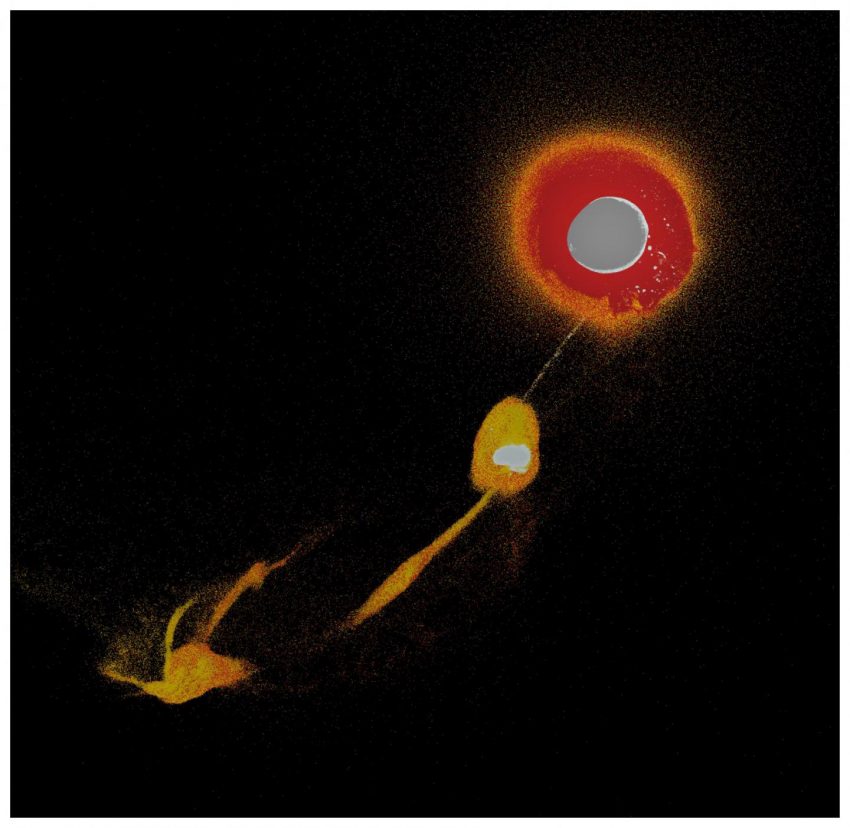
The formation of the Moon billions of years ago is cloaked in mystery. Most astronomers believe the young Earth, still cooling off from its formation, was struck by a mars-sized body called Theia, roughly 4.5 billion years ago.
As the proto-Moon orbited Earth, it cooled, and gathered debris from the surrounding region of space. At the time, the Moon was much closer to Earth than it is today. Over billions of years, gravitational forces between the Earth and the Moon resulted in our planetary companion moving further away from our home world.
Spinning the story a bit…
Researchers at Durham University developed supercomputer simulations, showing how this ancient collision may have unfolded.
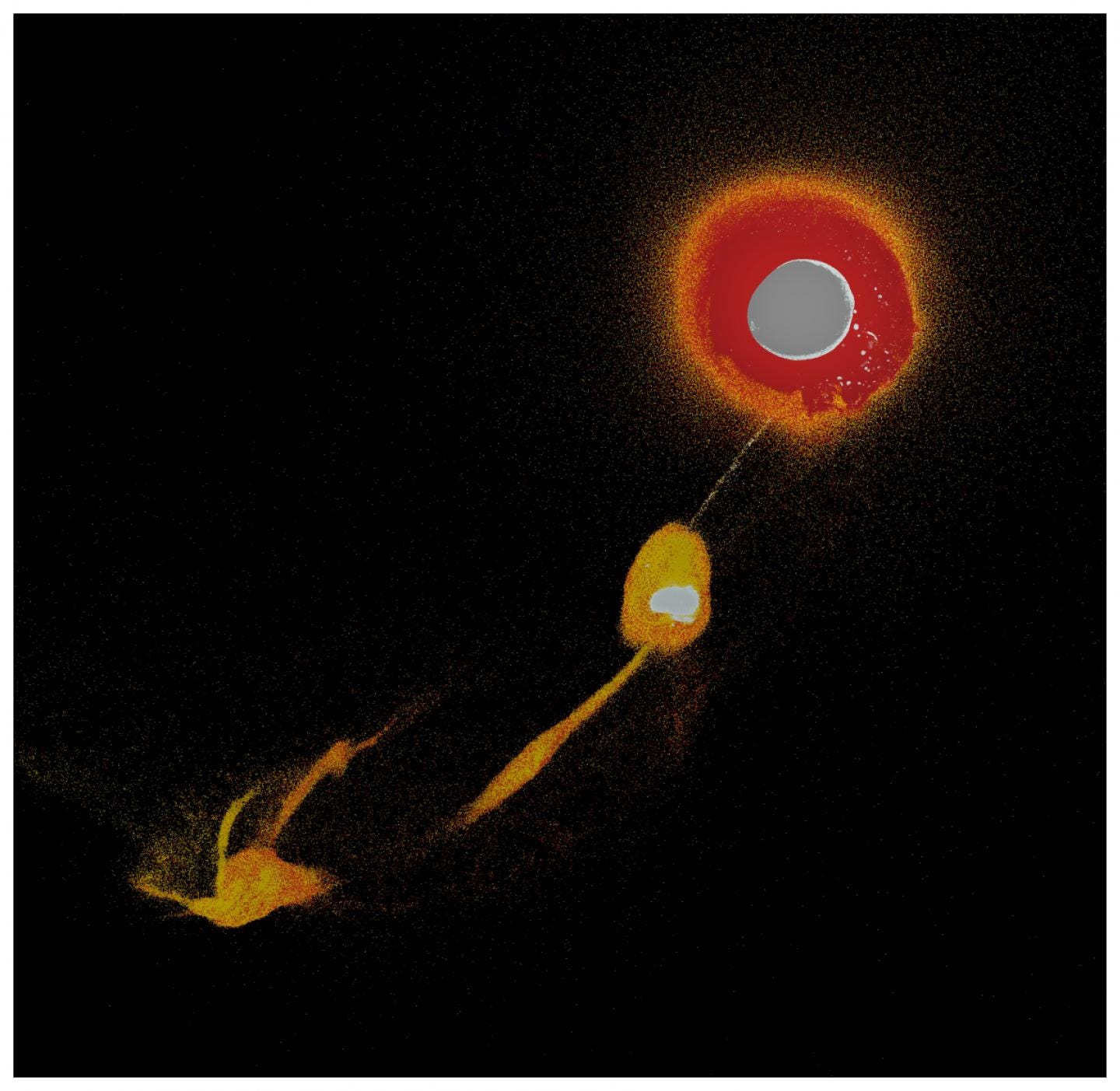
The velocity of Theia and the angle of impact affected the collision, as did the rotational rate of the body. The team of investigators examined a wide range of possible conditions, ranging from no spin to a quick rotation, and from glancing blows to more direct impacts.
Interestingly, when simulations tested the effect of a non-spinning version of Theia, the impact resulted in a satellite with roughly 80 percent of the mass of the Moon. Adding just a small amount of spin resulted in a second Moon in orbit around Earth.
Some of the impacts studied resulted in merging of the early Earth and Theia, while others showed just a glancing blow between the bodies.
“Among the resulting debris disc in some impacts, we find a self-gravitating clump of material. It is roughly the mass of the Moon, contains [about one percent] iron like the Moon… The clump contains mainly impactor material near its core but becomes increasingly enriched in proto-Earth material near its surface,” researchers describe in an article describing the study, published in Monthly Notices of the Royal Astronomical Society.
As the young proto-Moon settled into orbit around the Earth, the young body likely grew by collecting debris from the space around our homeworld. This body was seen developing a small iron core, surrounded by material from both Theia and the early Earth, similar to what we see on the Moon.
“It’s exciting that some of our simulations produced this orbiting clump of material that is relatively not much smaller than the Moon, with a disc of additional material around the post-impact Earth that would help the clump grow in mass over time… I wouldn’t say that this is the Moon, but it’s certainly a very interesting place to continue looking,” Dr. Sergio Ruiz-Bonilla in the Institute for Computational Cosmology at Durham University, said.
Researchers will continue refining models, examining how mass, velocity, spin, and other factors could affect the impact that formed the Moon.