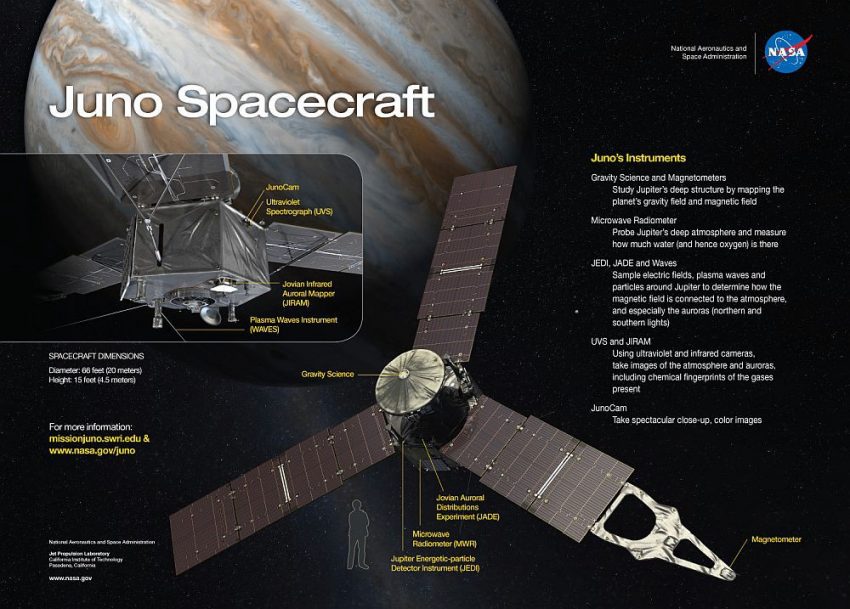
The Juno spacecraft, orbiting Jupiter since 2016, has a new lease on life, thanks to NASA. This robotic explorer is now due to continue its mission, at least until September 2025.
A mission extension recently granted by NASA extends the Juno program means the spacecraft will continue to gather science about the largest planet in our Solar System and its retinue of dozens of moons. Some of these moons are known to have water (particularly Europa), and they may be among the most-likely places in the Solar System where we might find primitive life.
“Since its first orbit in 2016, Juno has delivered one revelation after another about the inner workings of this massive gas giant. With the extended mission, we will answer fundamental questions that arose during Juno’s prime mission while reaching beyond the planet to explore Jupiter’s ring system and Galilean satellites,” Scott Bolton of the Southwest Research Institute, states.
Juno what?
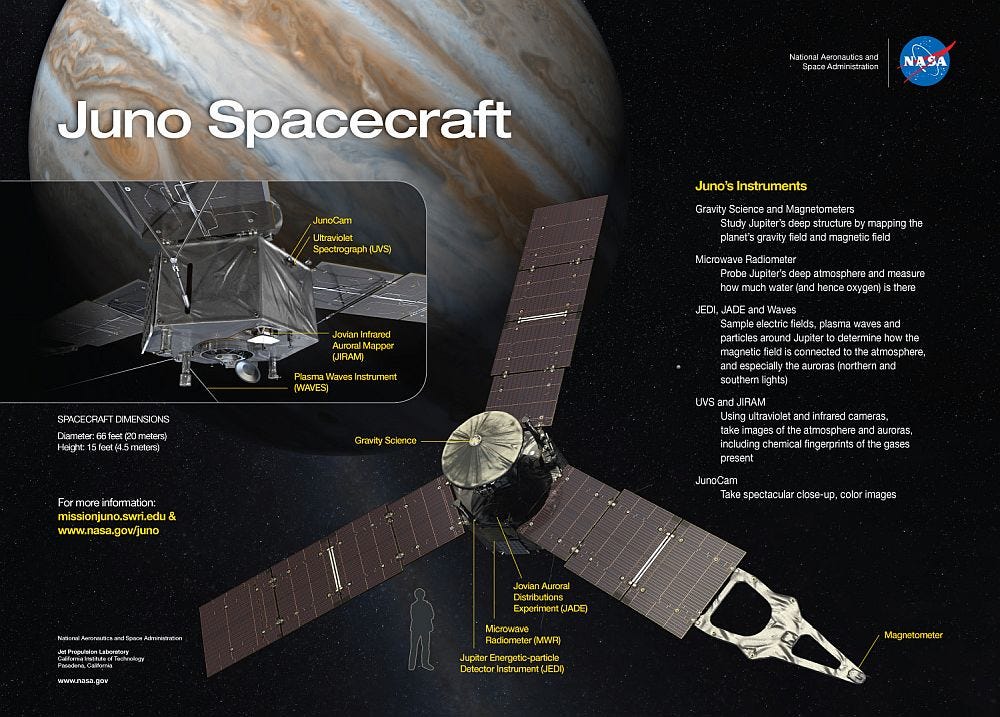
The Juno spacecraft, first proposed in 2003, launched to Jupiter in 2011. Its primary mission, to explore how Jupiter formed and developed over time, was set to complete in July 2021.
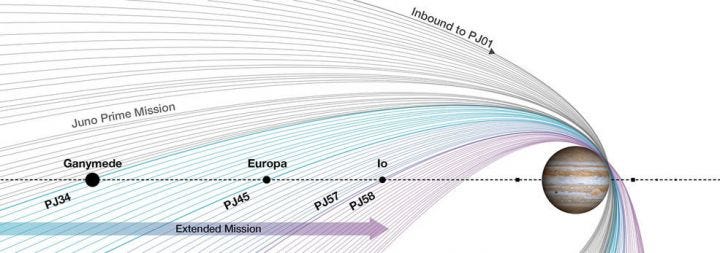
This extended mission includes 42 additional orbits of Jupiter, including flybys of its moons Ganymede, Io, and Europa. Observations will also be taken of polar cyclones at the poles of Jupiter, and NASA will undertake the first-ever detailed study of the faint ring system encircling the planet.
Not only will these flybys provide amazing views and data concerning the moons of this mighty world, but these close encounters will also result in a shorter orbit, increasing the number of orbits Juno is able to complete.
“The mission designers have done an amazing job crafting an extended mission that conserves the mission’s single most valuable onboard resource — fuel. Gravity assists from multiple satellite flybys steer our spacecraft through the Jovian system while providing a wealth of science opportunities,” Ed Hirst, Juno project manager at Jet Propulsion Laboratory (JPL) states.
The satellite flybys begin June 7, 2021, when Juno will pass low over Ganymede, reducing the orbital period of the spacecraft from 53 to 43 days. This pass will also send Juno hurtling toward the water moon of Europa. Following its arrival there on September 29, 2022, the orbital period of Juno will fall to 38 days. Another pair of encounters — on December 30, 2023 and February 3, 2024 — will reduce the time it takes Juno to orbit Jupiter down to just 33 days — roughly 63 percent of its original period.
Of course, technical issues or an accident could always silence Juno before the planned mission expires. But, Juno is ready to explore this fascinating system for years to come.
Although, I would TOTALLY listen to that station…

“Billy is face to face with outer space… Messages from distant stars… The local police calling all cars, radio waves… Hear them radio waves, radio waves…” — Radio Waves, Roger Waters
Juno also recently detected FM radio waves coming from one of Jupiter’s largest moons, Ganymede. The waves were detected in magnetic lines connecting Ganymede to the polar regions of Jupiter.
However, this is not likely to be the result of an extraterrestrial Wolfman Jack broadcasting out the biggest hits of Jupiter.
“It’s not E.T. It’s more of a natural function,” NASA spokesperson Patrick Wiggens tells KTVX in Utah.
Radio emissions around Jupiter, first detected in 1955, have been studied by researchers for decades.
The signal, seen for just five seconds as the spacecraft screamed past Ganymede at 180,000 KPH (nearly 112,000 MPH), was likely the result of electrons amplifying radio waves, in a process called cyclotron maser instability (CMI). This same effect, which likely resulted in the detection, can also generate ultraviolet auroras, also seen by Juno.
Over the coming years, Juno will provide ongoing data to researchers managing future missions to Jupiter, including NASA’s Europa Clipper and the JUpiter ICy moons Explorer (JUICE) mission from the European Space Agency.