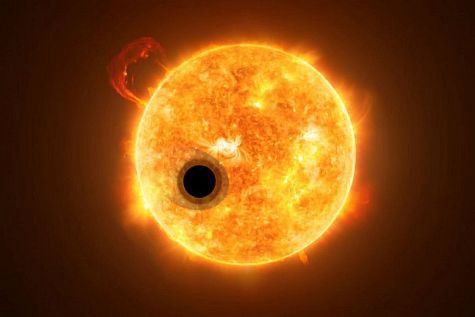
The exoplanet WASP-107b may be as large as Jupiter, but this super-puff planet only contains one-tenth as much mass as the king of our Solar System. The density of this world is lower than what astronomers thought possible.
The discovery of this bizarre exoplanet — sometimes called a cotton candy planet — provides astronomers with a unique target for further study.
“With a mass in the Neptune regime and a radius of Jupiter, WASP-107b presents a challenge to planet formation theories. Meanwhile, the planet’s low surface gravity and the star’s brightness also make it one of the most favorable targets for atmospheric characterization,” researchers explain in The Astronomical Journal.
Look… up in the sky! It’s super-puff!
This study, headed by Caroline Piaulet, a Ph.D. student at the Université de Montréal’s (UdeM) Institute for Research on Exoplanets (iREx), suggests other such cotton candy worlds may be found in other solar systems.
Planets form within protoplanetary disks of gas and dust surrounding young stars. Astronomers seeking to understand the formation of gas giants is largely based on the only examples we knew until recently — Jupiter and Saturn.
[Read: ]
Calculations suggested planetary cores needed to have masses at least 10 times greater than Earth in order to collect the vast amounts of gas needed to form a gas giant — far greater than WASP-107b. So, how did this cotton candy planet take shape?
“For WASP-107b, the most plausible scenario is that the planet formed far away from the star, where the gas in the disc is cold enough that gas accretion can occur very quickly. The planet was later able to migrate to its current position, either through interactions with the disc or with other planets in the system,” Eve Lee of McGill University stated.
Because exoplanets don’t care what humans think is impossible
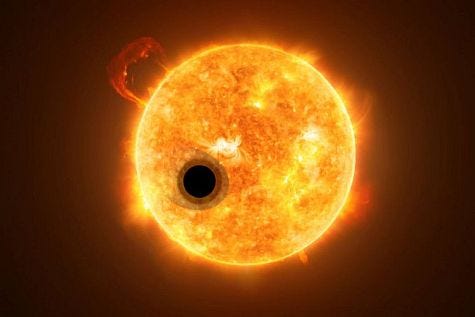
Super-puff planets are the least dense of all exoplanets. Even these, however, were thought to have a lower limit to their densities. This new study challenges these old assumptions.
Piaulet’s team analyzed data recorded at the Keck Observatory in Hawaii, in order to better understand the mass and composition of this exoplanet, discovered in 2017.
They utilized the radial velocity method, examining the wobble created by a star as a planet orbits around it. The team determined that WASP-107b is centered on a solid core just four times more massive than Earth.
This would suggest that over 85% of the mass of the world is contained in its atmosphere. Neptune — the most similar planet in our solar system — holds just 10 to 15% of its mass in its atmosphere.
“We had a lot of questions about WASP-107b. How could a planet of such low-density form? And how did it keep its huge layer of gas from escaping, especially given the planet’s close proximity to its star?” Piaulet descibes.
Examination of the atmosphere of WASP-107b, using the Hubble Space Telescope, showed little methane in the air surrounding this unusual exoplanet, where researchers expected to find higher concentrations.
But, wait! There’s more!
“Cotton candy is the perfect snack for when I’m in the mood to eat dry, scratchy fabric.” — Demetri Martin
In the video above, take a look at what the exoplanet WASP-107b might look like in its orbit around its parent star.
Detailed observations of the WASP-107 planetary system also reveal the presence of a second exoplanet in the system. This larger planet, WASP-107c, is roughly one-third as massive as Jupiter, and orbits the central star in an elliptical orbit once every three years, compared to 5.7 days for WASP-107b.
“This work addresses the very foundations of how giant planets can form and grow. It provides concrete proof that massive accretion of a gas envelope can be triggered for cores that are much less massive than previously thought,” Björn Benneke, astrophysics professor at UdeM, stated.
Once the James Webb Space Telescope launches and becomes operational, astronomers will be able to get more-detailed studies of exoplanets and their atmospheres, including the worlds of WASP-107.
This article was originally published on The Cosmic Companion by James Maynard, founder and publisher of The Cosmic Companion. He is a New England native turned desert rat in Tucson, where he lives with his lovely wife, Nicole, and Max the Cat. You can read this original piece here.
Astronomy News with The Cosmic Companion is also available as a weekly podcast, carried on all major podcast providers. Tune in every Tuesday for updates on the latest astronomy news, and interviews with astronomers and other researchers working to uncover the nature of the Universe.