
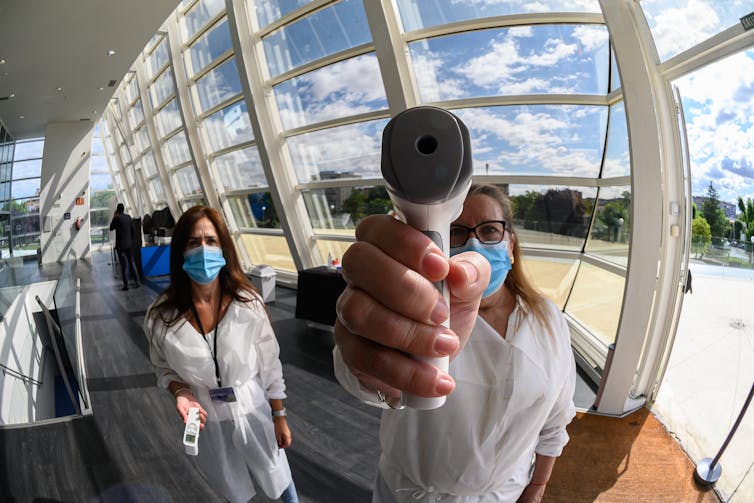
During the pandemic, the chances are that as you enter an airport or doctor’s surgery, someone will point an infrared thermometer at your forehead in order to assess your temperature. Your skin temperature is being measured to try to identify whether or not you have an increased deep body temperature, which is indicative of fever, one of the leading signs of COVID-19.
The good thing about using infrared thermometers is that they are quick, simple, and non-invasive. You can rapidly screen many people without inconveniencing them, for instance, travelers moving through an airport or people entering a sports stadium. But to be useful mass-screening tools, infrared thermometers also need to be accurate – and this is where problems arise.
Although fever is a leading symptom of COVID-19, many infected people don’t have any symptoms, or they develop a fever after they have become infectious, got ill, and entered the hospital. At least 11% of those with COVID-19 do not have a fever, and only 43% of patients ill enough to be admitted to the hospital have one. So, looking for fever is not a foolproof approach.
Plus, while an infrared thermometer can measure skin temperature accurately, the real question is: does forehead temperature tell us anything about deep body temperature, the true sign of fever? In certain, highly controlled circumstances, an increased forehead temperature can indicate a raised deep body temperature – this is why people put their hand on your forehead when you say you don’t feel very well.
[Read: ]
But the problem is, forehead or skin temperature can be increased or decreased independently of deep body temperature, for many reasons. Having just been in a cold or hot environment, sunburn, having just exercised, wearing too many clothes, having drunk alcohol, having just eaten, having a variety of skin conditions – these can all influence skin temperature.

Such factors can result in false positives, where someone is suspected of having a fever when they don’t, and false negatives, where someone passes a screening test but has a fever. Neither outcome is good. The former means people will have to be checked further or prevented from doing things. The latter means infected individuals gain access to places where they can spread the infection, or feel they are virus-free so don’t need to take other precautions, such as mask-wearing, social distancing, or washing their hands.
And even if an infrared thermometer could accurately identify individuals with a raised deep body temperature, is this always indicative of a fever? Again, the answer is obviously no. Other things can increase your deep body temperature, the most obvious being exercise, compounded by being in a hot place and wearing too many clothes. Just as might happen when you run from one airport terminal to another to catch a connecting flight.
All of the above has led the European Center for Disease Prevention and Control to conclude that, although some COVID-19 cases do get detected through temperature-screening procedures at airports, evidence indicates that such measures, on the whole, aren’t effective.
In the UK, the Medicines and Healthcare Products Regulatory Agency has similarly warned that “temperature screening products, some of which make direct claims to screen for COVID-19, are not a reliable way to detect if people have the virus.” The Canadian Agency for Drugs and Technologies in Health also noted years ago that “the accuracy of infrared skin thermometers is equivocal and requires more research.”
Hand-eye coordination
Given there remains a need for an accurate mass-screening method, and that infrared thermometers are already very popular, what can be done to improve their accuracy?
One way we have investigated may be to stick with the same kit, but change how it’s used a little. We know that the body’s extremities are more reactive to the overall thermal profile of the body – that fingers, for example, increase or decrease their temperature quite a lot as deep body temperature increases and decreases a little. In contrast, the head – in particular the corners of the eyes – are more consistent and reflective of deep body temperature.
Looking at these parts of the body and the difference in temperature between them could provide a more accurate indication of whether deep body temperature is raised due to fever. This would work because, in many scenarios in which deep body temperature increases, the temperature of the extremities also increases – for instance in exercise, when drinking alcohol, getting hot when wearing too many clothes, and so on. As a result, the difference between the temperature of the eye and fingers decreases.
But with fever, deep body temperature increases while the hands get colder, so the difference between the eye and finger temperature increases. Therefore, a more accurate way of using infrared thermometers to screen for COVID-19 might be to measure the temperature of the hand and the corner of the eye and determine the difference.
This wouldn’t be perfect. Other situations can also increase this difference, including some age-related conditions. And, as we’ve noted, not all infected people develop fever symptoms. But it would be a step in the right direction, and so is worthy of further consideration. COVID-19 is unlikely to be the last pandemic, and we owe it to future generations to learn what we can from this one to help prepare for the next.
This article by Mike Tipton, Professor of Human and Applied Physiology, University of Portsmouth and Igor Mekjavic, Researcher in Automation, Biocybernetics and Robotics, Jožef Stefan Institute, and Adjunct Professor, Simon Fraser University is republished from The Conversation under a Creative Commons license. Read the original article.