Everyone needs to know the time. Ever since the 17th century Dutch inventor Christiaan Huygens made the first pendulum clock, people have been thinking of good reasons to measure time more precisely.
Getting the time right is important in so many ways, from running a railway to doing millisecond trades on the stock market. Now, for most of us, our clocks are checking themselves against a signal from atomic clocks, like those on board the global positioning system (GPS) satellites.
But a recent study by two teams of scientists in Boulder, Colorado might mean those signals will get much more accurate, by paving the way to effectively allow us to redefine the second more precisely. Atomic clocks could become so accurate, in fact, that we could begin to measure previously imperceptible gravity waves.
Brief history of time
Modern clocks still use Huygens’ basic idea of an oscillator with a resonance – like a pendulum of a fixed length that will always move back and forth with the same frequency, or a bell that rings with a specific tone. This idea was greatly improved in the 18th century by John Harrison who realised that smaller, higher frequency oscillators have more stable and pure resonances, making clocks more reliable.
Nowadays, most everyday clocks use a tiny piece of quartz crystal in the shape of a miniature musical tuning fork, with very high frequency and stability. Not much has changed with this clock design in the past hundred years, although we’ve got better at making them cheaper more reproducible.
The massive difference these days is the way that we check – or “discipline” – quartz clocks. Up until 1955, you needed to keep correcting your clock by checking it against a very regular astronomical phenomenon, like the Sun or the moons of Jupiter. Now we discipline clocks against natural oscillations inside atoms.
The atomic clock was first built by Louis Essen. It was used to redefine the second in 1967, a definition that has remained the same since.
It works by counting the flipping frequency of a quantum property called spin in the electrons in caesium atoms. This natural atomic resonance is so sharp that you can tell if your quartz crystal clock signal wanders off in frequency by less than one part in 10¹⁵, that’s a millionth of a billionth. One second is officially defined as 9,192,631,770 caesium electron spin flips.
The fact we can make such accurately disciplined oscillators makes frequency and time the most precisely measured of all physical quantities. We send out signals from atomic clocks all over the world, and up into space via GPS. Anyone with a GPS receiver in their mobile phone has access to an astonishingly accurate time measurement device.
Read more: Why we will probably never have a perfect clock
If you can measure time and frequency accurately, then there are all kinds of other things you can accurately measure too. For example, measuring the spin flip frequency of certain atoms and molecules can tell you the strength of the magnetic field they experience, so if you can find the frequency precisely then you’ve also found the field strength precisely. The smallest possible magnetic field sensors work this way.
But can we make better clocks that allow us to measure frequency or time even more precisely? The answer might still be just as John Harrison found, to go higher in frequency.
The caesium spin flip resonance has a frequency corresponding to microwaves, but some atoms have nice sharp resonances for optical light, a million times higher in frequency. Optical atomic clocks have shown extremely stable comparisons with one another, at least when a pair of them is placed only a few metres apart.
Scientists are thinking about whether the international definition of the second could be redefined to make it more precise. But to achieve this, the different optical clocks that we would use to keep time precisely need to be trusted to read the same time even if they are in different labs thousands of miles apart. So far, such long distance tests have been not much better than for microwave clocks.
Better clocks
Now, using a new way of linking the clocks with ultra-fast lasers, researchers have shown that different kinds of optical atomic clocks can be placed a few kilometres apart and still agree within 1 part in 10¹⁸. This is just as good as previous measurements with pairs of identical clocks a few hundred metres apart, but about a hundred times more precise than achieved before with different clocks or large distances.
The authors of the new study compared multiple clocks based on different types of atoms – ytterbium, aluminium and strontium in their case. The strontium clock was situated in the University of Colorado and the other two were in the US National Institute of Standards and Technology, down the road.
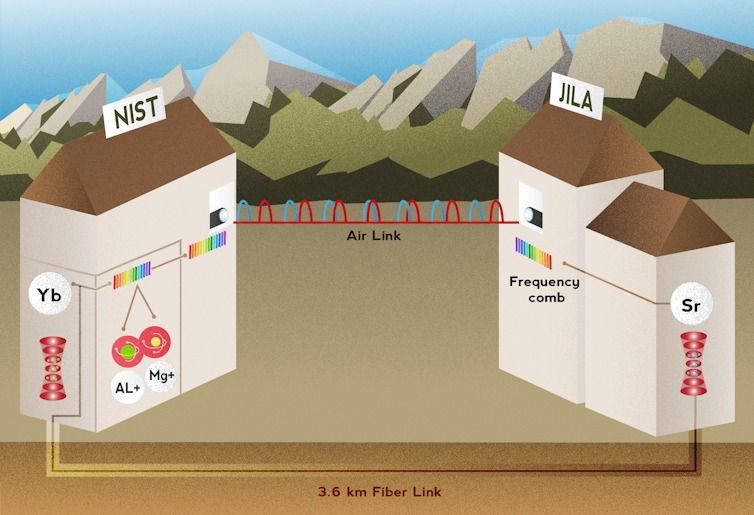
The study connected the clocks with a laser beam through the air over 1.5km from building to building, and this link was shown to be just as good as an optical fibre under the road, in spite of air turbulence.
But why do we need such accurate clocks? Although the atoms in the clock are supposed to be exactly the same wherever the clock sits and whoever looks at it, tiny useful differences can appear when the measurements of time are so precise.
According to Einstein’s theory of general relativity, gravity distorts space-time, and we can measure this distortion. Optical clocks have already been used to detect the difference in the Earth’s gravitational field by moving just a centimetre in height.
With more accurate clocks, maybe you could sense the creep in stress of the Earth’s crust and predict volcanic eruptions. Gravitational waves produced by distant black hole mergers have been seen – maybe we will now be able to detect much weaker waves from less cataclysmic events using a pair of satellites with optical clocks.
This article by Ben Murdin, Professor of Photonics and Quantum Sciences, University of Surrey, is republished from The Conversation under a Creative Commons license. Read the original article.