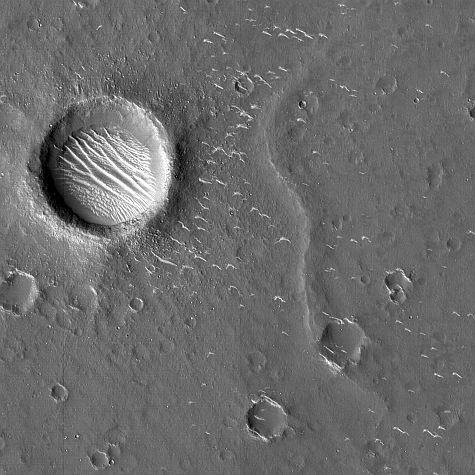
Commonly known as the Chinese Space Station Telescope (CSST), Xuntian (Heavenly Cruiser) is readying to become China’s first major telescope in space. Unlike previous space telescopes such as Hubble, this orbiting observatory, due for launch in 2024, will be orbiting alongside the Chinese large modular space station, able to dock with the outpost when needed.
One of the most-important characteristics of a telescope is its diameter — which limits how much light it can take in at a single time. The main mirror in Xuntian will have a diameter around two meters (six-and-a-half feet) across, roughly the size of the mirror at the heart of the Hubble Space Telescope. However, the CSST will be able to see 300 times as much sky at one time as its older compatriot.
“The telescope will be set up in an optical module that can fly independently in orbit… [W]e will make it fly approximately in common orbit with the future space station. This will help us refuel the telescope and carry out in-orbit upgrade[s] for it,” Zhou Jianping, a leader in China’s human spaceflight program, told China Central Television.
This pairing would represent a significant advantage in servicing over the Hubble telescope, which required several Shuttle missions to repair and upgrade.
Looking high, looking low, looking everywhere I go…
With its impressive field of view, the CSST (sporting a camera with 2.5 billion pixels) will be capable of studying 40 percent of the sky over 10 years. Examining the Cosmos in visible and ultraviolet light, Xuntian seeks to understand the nature of dark energy and dark matter, two of the greatest mysteries in astrophysics today.
“It can simultaneously perform the photometric imaging and spectroscopic slitless surveys, and will probe weak and strong gravitational lensing, galaxy clustering, individual galaxies and galaxy clusters, active galactic nucleus (AGNs), and so on,” researchers from the National Astronomical Observatories (NAOC) describe in a 2019 article.
Closer to home, the Chinese Space Station Telescope will study regions of space just beyond the most distant planet in our solar system, searching for signs of trans-Neptunian objects (TNOs). This new eye in the sky will also protect our own planet, keeping an eye out for near-Earth asteroids.
“If you plan for one year, plant rice. If you plan for ten years, plant trees. If you plan for 100 years, educate mankind.” Chinese Proverb
China is also building four research stations to study data collected by CSST, and the CNSA has started training crews to assemble this mighty observatory. Assembly of Xuntian will take place in space, consisting of four crewed and seven robotic missions to the orbiting telescope, scheduled for this year and next.
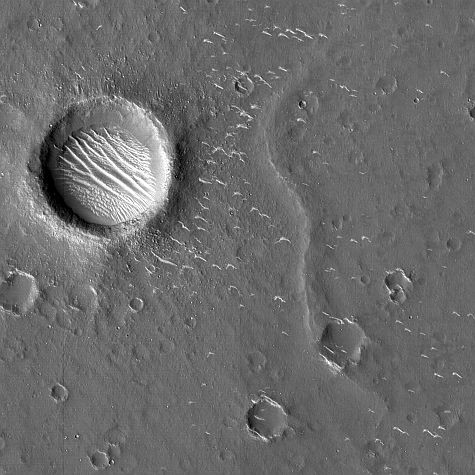
The Chinese space program has recently carried out some impressive missions, including Tianwen-1, an orbiter, lander, and rover now in parking orbit over Mars. This marks the first time at any nation placed all three varieties of exploratory craft at the Red Planet on their first attempt.
The core module of the Chinese space station, Tianhe (Harmony of the Heavens), could lift off before the end of April, although no public launch date has been announced. The module will be capable of supporting as many as three crew members for up to six months at a time.
Hit the play button above for a a look at Wang Yaping, China’s second woman in space, who may be one of the early residents of the Chinese space station. Video credit: New China TV (government media).
In 2011, China was prohibited by the United States Congress from participating in the International Space Station (ISS). A range of experiments from researchers from several nations will be carried out aboard the new Chinese space station soon after assembly is finished.
Once completed, the Chinese large modular space station will only be about the size of the Mir space station, and have a mass just 20 percent as great as the ISS.
But, it will have a really cool telescope.
This article was originally published on The Cosmic Companion by James Maynard, founder and publisher of The Cosmic Companion. He is a New England native turned desert rat in Tucson, where he lives with his lovely wife, Nicole, and Max the Cat. You can read this original piece here.