
A report from the US task force dedicated to investigating UFOs — or, in the official jargon, UAPs (Unidentified Aerial Phenomena) — has neither confirmed nor rejected the idea such sightings could indicate alien visits to Earth.
On Friday June 25, the Office of the Director of National Intelligence (ODNI) released its eagerly awaited unclassified intelligence report, titled “Preliminary Assessment: Unidentified Aerial Phenomena”.
The document is a brief nine-page version of a larger classified report provided to the Congressional Services and Armed Services Committees. It assesses “the threat posed by unidentified aerial phenomena (UAP) and the progress the Department of Defence Unidentified Aerial Phenomena Task Force has made in understanding this threat”.
The report certainly does not, as many were hoping, conclude UFOs are alien spacecraft. Rather, it shows the task force hasn’t made much progress since first being set up ten months ago. Perhaps this is unsurprising, given its task.
However, the task force’s very existence would have been unthinkable to many people just one year ago. It’s unprecedented to see the broader policy shift towards the acknowledgment of UFOs as real, anomalous physical phenomena that are worthy of extended scientific and military analysis.
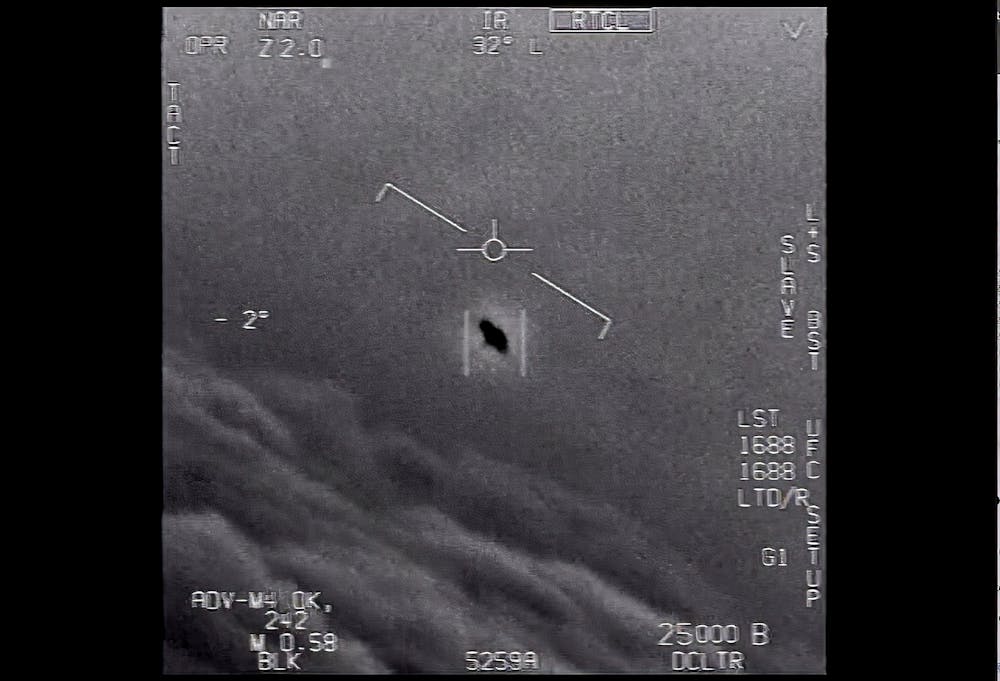
Seemingly advanced technologies
The report withholds specific details of its data sample, which consists of 144 UFO reports made mostly by military aviators between 2004 and 2021. Its bombshell finding is that “a handful of UAP appear to demonstrate advanced technology”.
This “handful” — 21 of the 144 reports — represents classic UFO enigmas. These objects:
appeared to remain stationary in winds aloft, move against the wind, maneuver abruptly, or move at considerable speed, without discernible means of propulsion. In a small number of cases, military aircraft systems processed radio frequency (RF) energy associated with UAP sightings.
These characteristics indicate some UAP may be intelligently controlled (because they aren’t blown around by the wind) and electromagnetic (as they emit radio frequencies).
In March, Former Director of National Intelligence John Ratcliffe told Fox News some reports describe objects “traveling at speeds that exceed the sound barrier without a sonic boom”. Sonic booms are sound waves generated by objects breaking the sound barrier.
No known aircraft can travel faster than sound without creating a sonic boom. NASA is currently developing “quiet supersonic technology”, which may allow planes to break the sound barrier while issuing a subdued “sonic thump”.
Some have claimed the objects are probably secret, advanced Russian or Chinese aircraft. However, global aerospace development has failed to match the flight characteristics of objects reported since the late 1940s. And it seems counterproductive to repeatedly fly secret aircraft into an adversary’s airspace where they can be documented.
How did we get here?
The report’s release is a profoundly important moment in the history of the UFO mystery, largely because of its institutional context. To fully appreciate what this moment might mean for the future of UFO studies, we have to understand how the UFO problem has been historically “institutionalized”.
In 1966, the US Air Force was facing increasing public pressure to resolve the UFO problem. Its effort to do so, then known as Project Blue Book, had become an organizational burden and a public relations problem.
It funded a two-year scientific study of UFOs based at the University of Colorado, headed by prominent physicist Edward Condon. The findings, published in 1969 as the Final Report on the Scientific Study of Unidentified Flying Objects, allowed the Air Force to end its UFO investigations.
Condon concluded nothing had come from the study of UFOs in the past 21 years that added to scientific knowledge. He also said, “further extensive study of UFOs probably cannot be justified in the expectation that science will be advanced thereby”.
Nature, one of the world’s most reputable scientific journals, described the Condon Report as a “sledgehammer for nuts”. But by then the Air Force had collected 12,618 reports as part of Project Blue Book, of which 701 sightings were categorized as “unidentified”.
Unlike the new Pentagon report, the Condon Report didn’t find any UFOs that appeared to demonstrate advanced technology. The most problematic cases were resolved by being categorized ambiguously. Here’s one example:
This unusual sighting should therefore be assigned to the category of some almost certainly natural phenomenon which is so rare that it apparently has never been reported before or since.
With this strategic category in the toolkit, there was no need to acknowledge seemingly advanced technology exhibited by UAPs. Indeed, they were deliberately filtered from institutional knowledge.
Recovering from ‘institutional forgetting’
For most of their postwar history, UFO reports have been regarded by state institutions as knowledge out of place, or “information pollution” — something to be excluded, ignored, or forgotten.
The Pentagon’s UAP task force represents an abrupt reversal of this long-standing organizational policy. UFO reports, made primarily by military personnel, are no longer pollutants. They are now important data with national security implications.
That said, they do still represent “uncomfortable knowledge”. As the late Oxford University anthropologist Steve Rayner observed, knowledge can be “uncomfortable” for institutions in two ways.
First, Rayner said, “acknowledging potential information by admitting it to the realm of what is ‘known’ may undermine the organizational principles of a society or organization”.
Meanwhile, he said “not admitting such information may also have serious deleterious effects on institutions, either directly or by making them prone to criticism from other parts of society that they ‘ought’ to have known”. Both aspects describe the institutional context of UFO information.
The US Department of Defence has confirmed UFOs threaten flight safety, and potentially, national security. In doing so, it has exposed a weakness in its organizational principles. It has admitted it’s not very good at knowing what UFOs are.
It also faces the criticism that seven decades after UFOs first appeared on the radar, it ought to know what they are. The new Pentagon report doesn’t compel us to accept the reality of alien visitation. But it does compel us to take UFOs seriously.
Article by Adam Dodd, Tutor, The University of Queensland
This article is republished from The Conversation under a Creative Commons license. Read the original article.