On June 25, astronauts Shane Kimbrough and Thomas Pesquet successfully completed an almost seven-hour EVA (extravehicular activity, or spacewalk) to install solar panels on the International Space Station. What does it take to don a spacesuit and venture out on such a technical and dangerous mission? Surprisingly, one of the main criteria (besides the years of astronaut training) is body size.
EVA capabilities blossomed during the era of NASA’s space shuttle. Astronauts rode robotic arms, floated tetherless through the void using jetpacks to steer, corralled satellites by hand, and built the International Space Station (ISS). They’ve done it all while wearing spacesuits based on the design first developed for the Apollo missions in the 1960s.
Each suit is a human-shaped spacecraft, featuring a backpack that houses a primary life support system; a layered, pressurized outer garment to protect astronauts from the space environment; and a “long john” undergarment that circulates chilled water via tubes over the body to stop the astronauts getting too hot inside their suit.
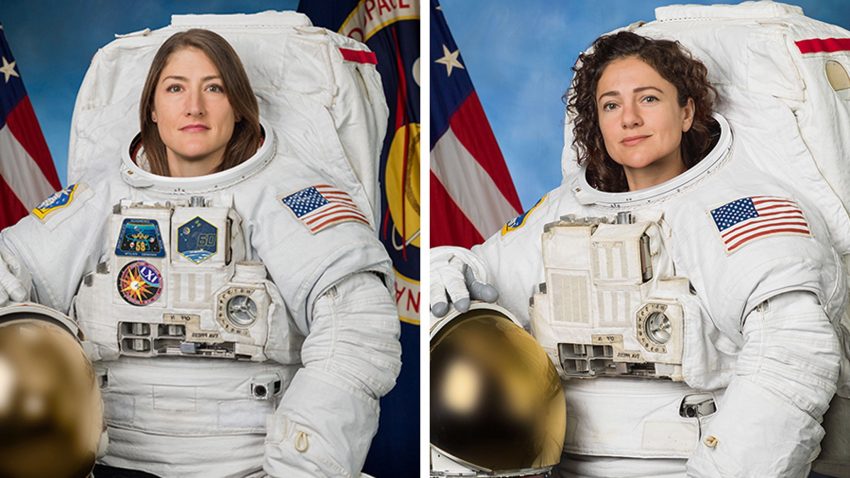
When designing these “next-gen” spacesuits in 1974, NASA opted for a modular “tuxedo” approach, in which the various components (upper torso, lower torso, helmet, arms, and gloves) could be mixed and matched to fit individual astronauts. The suits came in five sizes, from extra small to extra large, and were based primarily on male body shapes — females were not eligible for NASA’s astronaut program until 1978.
Fast-forward 47 years and Kimbrough and Pesquet were wearing those exact same spacesuits while working on the ISS, despite the fact the suits were only designed to last 15 years.
These days, NASA’s spacesuits are less like bespoke tailoring and more like remainder stock at an outlet mall; of the 18 suits originally made by the next-gen program, only four full suits remain. Four were lost in the Challenger and Columbia disasters, and others came to the end of their working lives and weren’t replaced.
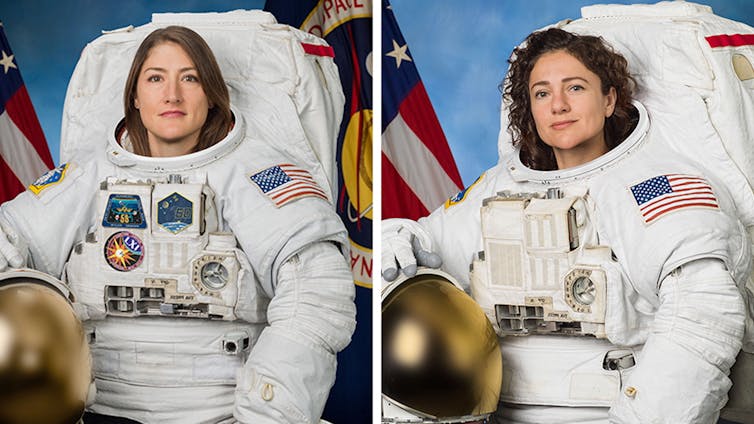
This means that to be selected for an ISS spacewalk, an astronaut must fit one of the two remaining available sizes: men’s medium, or men’s large. The first all-female EVA, planned for March 2019, had to be postponed because only one medium-sized suit was available. Another medium suit was eventually cobbled together from spares, and astronauts Christina Koch and Jessica Meir successfully performed their groundbreaking spacewalk on October 18, 2019.
Most EVAs are conducted in pairs, and flight controllers meticulously choreograph each astronaut’s activities well in advance, to minimize “idle” time and complete the tasks as efficiently as possible.
Each EVA participant undergoes up to ten hours of training per hour of EVA time, in a 12-meter-deep pool in which astronauts practice every aspect of their spacewalk, using life-sized mock-ups of ISS components.
During the actual EVA, mission controllers on the ground keep a watchful eye on the astronauts’ progress, and the astronauts can communicate with ground control, their EVA buddy, and ISS crewmates as required.
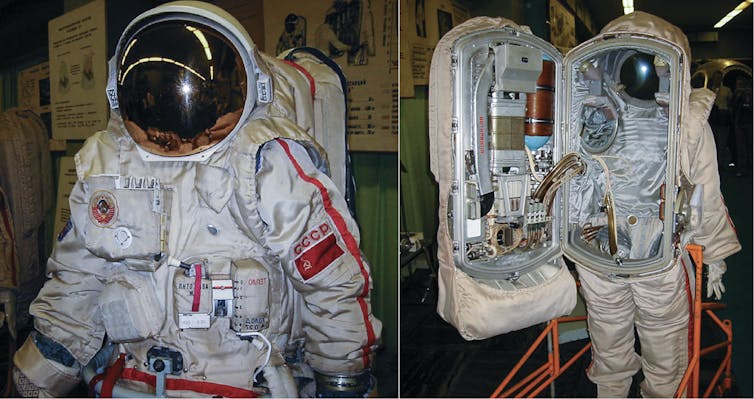
Space is a harsh environment. The spacesuit provides protection against radiation, temperature extremes (ranging from -270℃ to +120℃), and small particles of debris. To guard against the risk of being hit by “space junk”, EVAs are scheduled for periods of low risk, based on the tracking of known objects.
Astronauts must also take steps to avoid decompression sickness, or “the bends”. Much like a scuba diver ascending too fast from a deep dive, an astronaut who moves too fast from the pressurized space station to the lower pressure inside their spacesuit can suffer painful and potentially deadly bubbles of nitrogen forming in their bloodstream. Before an EVA, astronauts “camp out” overnight in the ISS airlock at a reduced pressure, to help acclimatize before donning their spacesuit.
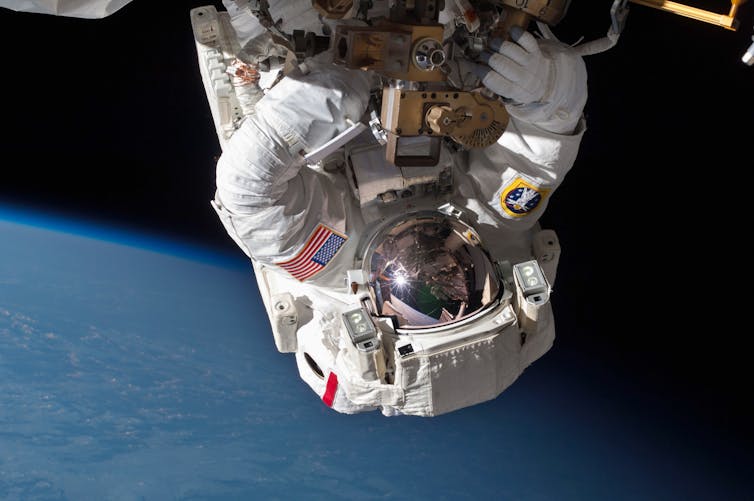
No one has died during an EVA, but there have been some close calls. The first-ever spacewalk, by Soviet cosmonaut Alexei Leonov in 1965, almost ended in disaster when the expansion of his suit in the vacuum of space almost prevented him from re-entering the Voskhod capsule.
And on July 16, 2013, Luca Parmitano entered the history books with two firsts: the first Italian to perform a spacewalk, and the first near-drowning in space. A week before his EVA, one of the water pipes in his spacesuit had sprung a leak. But this information was not passed up the chain of command, and mission controllers authorized his EVA to begin.
Within an hour Luca had almost two liters of water in his helmet, leaving him struggling to breathe. Unable to see out of his visor or communicate with colleagues, Luca said he used his tether to navigate his way back to the safety of the airlock.
No doubt he and other astronauts will be keen to don NASA’s new “exploration extravehicular mobility unit (xEMU)” spacesuits currently under development for the Artemis program, NASA’s long-awaited return to the Moon.
Hopefully, the Artemis moonwalkers will have more options when donning their suit, meaning astronauts can be selected for missions because they’ve got the right stuff, without also needing to be the right size.
Article by Steven Moore, Professor/Deputy Dean Research, School of Engineering and Technology, CQUniversity Australia
This article is republished from The Conversation under a Creative Commons license. Read the original article.