If you’ve ever felt your noisy open-plan office makes you cranky and sends your heart racing, our new research shows you aren’t imagining it.
Prior to the pandemic 70% of office-based employees worked in open-plan offices. Employee complaints about this design are rife.
Yet there is little experimental research investigating the effects of office noise on things like cognitive performance, physiological stress , and mood.
The results of our study, in experimentally controlled conditions using heart rate, skin conductivity, and AI facial emotion recognition, shows the effects of that noise are very real.
We’ve found a significant causal relationship between open-plan office noise and physiological stress.
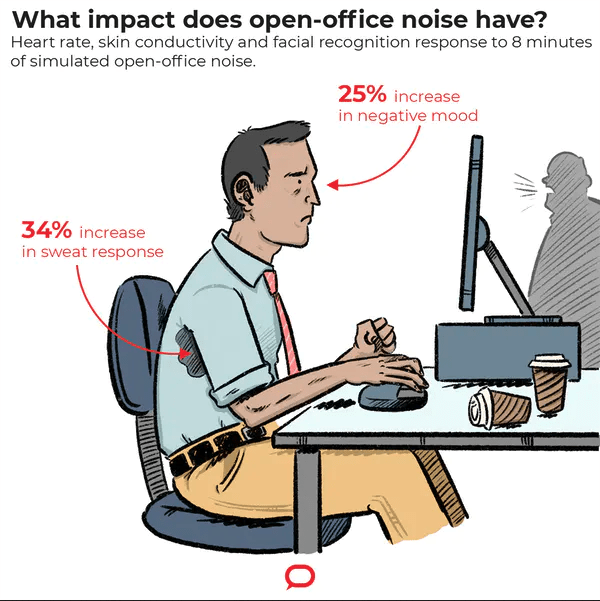
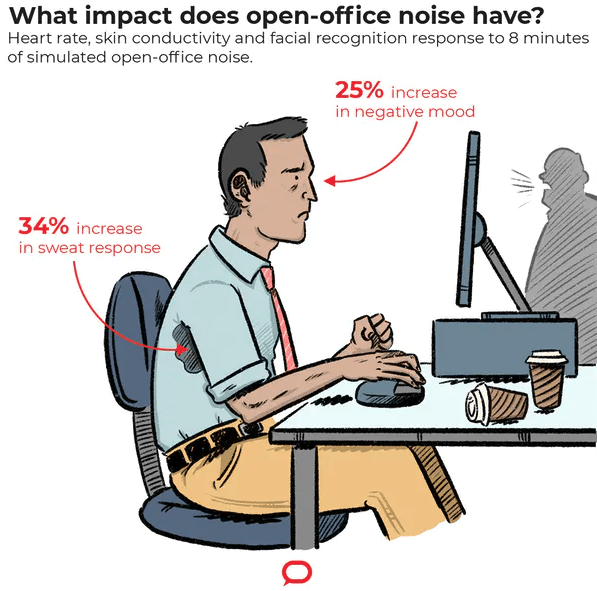
Our results show such noise heightens negative mood by 25% — and these results come from testing participants in a simulated open-plan office for just eight minutes at a time. In a real office, where workers are exposed to noise continuously during the day, we would expect the effects on stress and mood to be even greater.
How we simulated open-plan office noise
We used a simulated office setting with volunteers to compare the effects of typical open-plan office noise to a quieter private office on a range of objective and subjective measures of well-being and performance. Our carefully manipulated soundscapes included people speaking, walking, printing papers, ringing telephones, and keyboard typing noises.
Our study involved observing the same individuals “working” — participants were asked to complete a proof-reading task — under the two noise conditions. We varied the order of the sound tests to avoid bias due to fatigue and training effects.
This “repeated measures experimental design” allowed us to make causal conclusions about the effects of the noise on well-being indicators.
We used sensors to track changes in heart rate and sweat response — both reliable indicators of physiological stress. We used facial emotion recognition software to assess emotional responses. We also had participants self-report their own feeling using a mood scale.
Even after a short exposure, we found a causal relationship between open-plan office noise and both stress and negative mood. Negative mood increased by 25% and sweat response by 34%.
While there was no immediate effect on reduced work performance, it is reasonable to assume such hidden stress over the longer term is detrimental to well-being and productivity.
Precise causal relationships
Our study addresses a gap in the literature by using a simulated office environment with objectively manipulated noise levels and a wide range of objective and subjective dependent variables.
Reviews in research in this field show past studies have tended to only use self-reported measures. They have not used controlled experimental conditions, nor tested sound parameters.
Comparing multiple output measures has allowed us to investigate cause-effect relationships. Much research on open-plan offices has not established direct causal connections, which is necessary to understand precise relationships, and thus the how to most effectively and efficiently reduce these stressors.
Although open-plan offices rarely present an immediate physical danger in terms of sound levels, unrelenting exposure all day intensifies their effects.
Chronically elevated levels of physiological stress are known to be detrimental to mental and physical health.
Frequently being in a negative mood is also likely to harm job satisfaction and commitment. It potentially increases the likelihood of employees leaving.
What to do about it
The pandemic has changed our tolerance for office work. Surveys show up to 70% of employees will seek new jobs if their employer does not offer flexibility to work from home some of the time. So creating a healthy work environment is more important than ever.
As organizations seek to adapt to COVID-19, many are reconsidering how they set up and use the office. Though open-plan offices are unlikely to go away any time soon, our study highlights the importance of understanding employee needs in designing work spaces.
One advantage of more employees working from home at least some of the time is a less crowded office, reducing both visual and auditory distractions.
But there are other things that can be done. Acoustic treatments and sound-masking technologies — ambient sounds designed to make other people talking less intrusive — can help. Good old-fashioned walls or partitions may also assist.
Such interventions can be costly, but so is the impact of poor office environmental quality on productivity.
And we might all feel happier about going back to the office.
Article by Libby (Elizabeth) Sander, Assistant Professor of Organisational Behaviour, Bond Business School, Bond University.
This article is republished from The Conversation under a Creative Commons license. Read the original article.