
I have been popularizing quantum physics, my area of research, for many years now. The general public finds the topic fascinating and covers of books and magazines often draw on its mystery. A number of misconceptions have arisen in this area of physics and my purpose here is to look at the facts to debunk seven of these myths.
Don’t worry, you don’t need to know much about quantum physics to read this article. I will mostly be explaining what quantum physics isn’t, rather than what it is…
1. “Quantum physics is all about uncertainty”
Wrong! Quantum physics is probably the most precise scientific discipline ever devised by humankind. It can predict certain properties with extreme accuracy, to 10 decimal places, which later experiments confirm exactly.
This myth originated partly in Werner Heisenberg’s “uncertainty principle”. He showed that there is a limit to how accurately two quantities – for instance, a particle’s speed and its position – can be measured simultaneously. When quantum physics is used to calculate other quantities, such as the energy, or the magnetic property of atoms, it is astounding in its precision.
2. “Quantum physics can’t be visualized.”
Quantum physics describes objects that are often “strange” and difficult to put into pictures: wave functions, superimposed states, probability amplitude, complex numbers to name but a few. People often say that they can only be understood with mathematical equations and symbols. And yet we physicists are always making representations of it when we teach and popularise it. We use graphs, drawings, metaphors, projections, and many other devices. This is just as well, because students and even veteran quantum physicists like us need a mental image of the objects being manipulated. The contentious part is the accuracy of these images, as it is difficult to represent a quantum object accurately.
Working together with designers, illustrators, and video makers, the Physics Reimagined research team seeks to “draw” quantum physics in all its forms: folding activities, graphic novels, sculptures, 3D animations, and on and on.

3. “Even scientists don’t really understand quantum physics”
One of the leading lights in the field, Richard Feynman himself said: “I think I can safely say that nobody understands quantum mechanics.” But he then immediately added: “I am going to tell you what nature behaves like.” Niels Bohr, one of the founding fathers of the discipline, gives a good summary: “Those who are not shocked when they first come across quantum theory cannot possibly have understood it.”
Physicists do understand what they’re doing when they’re manipulating the quantum formalism. They just need to adapt their intuitions to this new field and its inherent paradoxes.
4. “A few brilliant theorists came up with the entire concept of quantum physics”
The entire history of quantum physics shows the exact opposite: at the very beginning, lab experiments threw up unexpected results, such as the photoelectric effect, black-body radiation, the light emission spectrum of atoms. Only later did brilliant theorists enter the scene, when Albert Einstein, Max Planck, Niels Bohr and others tried to provide explanations.
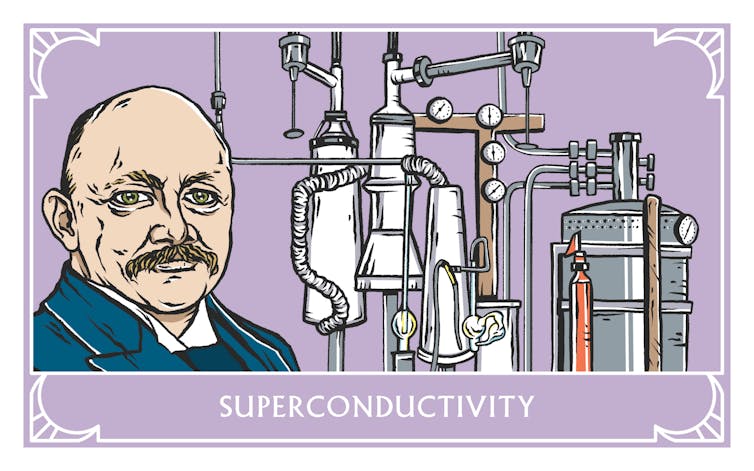
Further fundamental experiments followed, including electrons that bounced weirdly off nickel, silver atoms strangely deviated by a magnetic field, a perfectly conducting metal at low temperatures and so on. Theories and concepts then emerged once again: duality, spin or superconductivity were introduced. The highly productive “back and forth” exchanges between theory and practice are what physics is built on. Experiments generally come first, except in very few cases.
5. “Einstein was quantum physics’ worst enemy”
Poor old Albert Einstein is often depicted as having been a virulent opponent of quantum physics, probably because of his famous quote, “God does not play dice with the universe.” Yet he wasn’t against it and what’s more, he created it! In 1905 Einstein wrote his foundational article, “On a Heuristic Viewpoint Concerning the Production and Transformation of Light”, based on the work of Max Planck. In it, he proposed that light was made of small, individual, and quantified bodies, called photons. This is what won him the Nobel Prize, in fact, not his work on the theory of relativity.
Einstein probably earned that reputation because of his discussions with Niels Bohr, especially on the idea of interpretation and quantum reality, as he didn’t accept the concept of nonlocality. Later, experiments on entanglement and violation of Bell’s theorem proved him wrong and showed the absence of hidden variables. Einstein fully appreciated the relevance of quantum physics, he just had a few problems with some of its implications, especially as regards locality.
6. “Quantum physics has no practical use”
Quantum physics is probably the most useful discipline in modern physics: once physicists understood how light, atoms and electrons worked, they were able to manipulate them. Lasers, MRI in hospitals, LEDs, flash memory, hard disks – and above all else, the transistor and electronics – all of these technologies were invented by quantum physicists.

7. “Quantum physics might explain certain alternative therapies and other mysteries”
Many people who believe in paranormal phenomena and in certain “therapies” claim to be inspired by quantum physics. Indian-American Deepak Chopra is one of the most famous proponents of this approach. He has developed a kind of quantum mysticism in which a pseudo-New Age spirituality finds its credentials in scientific jargon such as “human quantum-body essence”, “localized field of energy and information with cybernetic feedback loops”, and “harmonization of the quantum mechanical body”. He then purports to establish quantum relationships between mind, consciousness, matter, and the universe. “Quantum therapies” also offer care protocols based on the body seen as “a vibration and energy field”, host to “vibrating states” and “bioresonances”.
This is dishonest on two counts. The first trick consists in using scientific terms to mystify quantum physics, when there is in fact no mystery. Lab experiments and daily living have shown its validity. On the other hand, none of the phenomena described by these therapies or beliefs have any scientific basis. Above all, words denote very precise meanings in quantum physics and they are entirely misused in these pseudo-sciences.
More cheating can be found when quantum properties are extrapolated to a human scale. To be absolutely clear, quantum properties such as superposition of states or quantization don’t apply in the living world on a human scale. 2012 Nobel Prize–winner Serge Haroche proved this with his experiments. When an object interacts too much with its environment and becomes too large, it is no longer a quantum object.
However, I wouldn’t like to judge those who wish to test this approach, which belongs to the realm of belief, not science. Everyone can do as they wish, of course. I would only ask people to refrain from pretending it has any scientific basis in quantum physics. Any such claim is simply false.
This article by Julien Bobroff, Professor of Physics at Université Paris-Saclay is republished from The Conversation under a Creative Commons license. Read the original article.