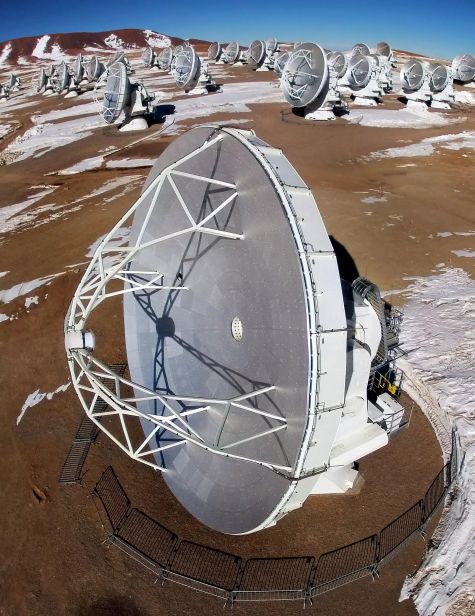
ALMA loving, I will give to you…
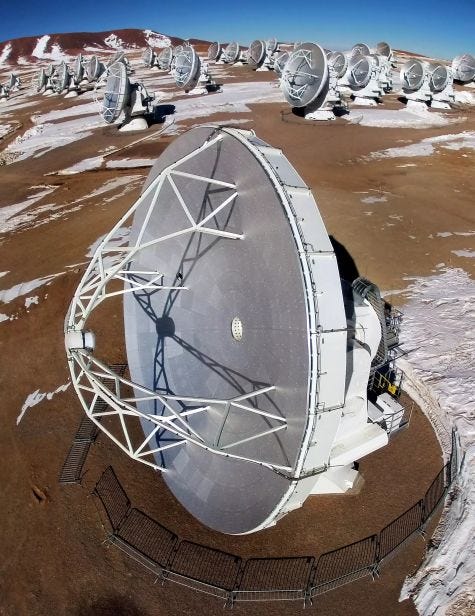
Using the Atacama Large Millimeter/submillimeter Array (ALMA), astronomers were able to see Io as it passed into the shadow of Jupiter, where sulfur dioxide gas freezes, falling out of the atmosphere of the Galilean moon.
“When Io passes into Jupiter’s shadow, and is out of direct sunlight, it is too cold for sulfur dioxide gas, and it condenses onto Io’s surface. During that time we can only see volcanically-sourced sulfur dioxide. We can therefore see exactly how much of the atmosphere is impacted by volcanic activity,” explained Statia Luszcz-Cook from Columbia University, New York.
Using this instrument, astronomers examined sulfur monoxide (SO) and sulfur dioxide (SO2) rising up from volcanoes. Study of the data revealed volcanic releases constitute 30 to 50 percent of the atmosphere of Io.
As Io entered the shadow of Jupiter “the SO2 flux density dropped exponentially, and the atmosphere reformed in a linear fashion when re-emerging in sunlight, with a ‘post-eclipse brightening’ after ∼10 minutes. While both the in-eclipse decrease and in-sunlight increase in SO was more gradual than for SO2, the fact that SO decreased at all is evidence that self-reactions at the surface are important and fast, and that in-sunlight photolysis of SO2 is the dominant source of SO,” researchers describe in The Planetary Science Journal.
The third, unexpected, gas was also found — potassium chloride (KCl).
“We see KCl in volcanic regions where we do not see SO2 or SO. This is strong evidence that the magma reservoirs are different under different volcanoes,” Luszcz-Cook stated.
Like our own moon, Io is tidally locked to its home planet, with one side always facing Jupiter. This condition, plus the gravitational tug of two of Jupiter’s other large moons, Europa and Ganymede, pull on Io like taffy, creating heating within the moon.
This movement also creates large volcanoes, like Loki Patera, which stretches 200 kilometers (124 miles) across the face of this Jovian moon.
Io, first seen by Galileo more than 400 years ago, continues to fascinate us today.
This article was originally published on The Cosmic Companion by James Maynard, founder and publisher of The Cosmic Companion. He is a New England native turned desert rat in Tucson, where he lives with his lovely wife, Nicole, and Max the Cat. You can read this original piece here.
Astronomy News with The Cosmic Companion is also available as a weekly podcast, carried on all major podcast providers. Tune in every Tuesday for updates on the latest astronomy news, and interviews with astronomers and other researchers working to uncover the nature of the Universe.