There are more than 5.8 million cotton farmers in India according to the country’s Textile Ministry. Every year, they face heavy losses due to pests attacking their crops. In 2017, farmers in the state of Maharashtra faced a loss of ₹15,000 crores ($2.1 billion) as 50% of the crop was under attack from pests.
As a result, more than 55% of pesticide in India goes towards cotton farming. However, the wrong usage of these chemicals can damage the crop or reduce the quality.
That’s why Wadhwani AI, a research institute in India, started searching for solutions in 2018 to help farmers save their crops using insights from artificial intelligence.
Conceptualization and data collection
The idea of the AI model was to determine how many pests are seen in that area and send an advisory on pesticide usage. However, there was no prior field data to train the model. So the team had to build a special app to collect data.
Farmers already use pheromone traps to catch pests and predict if there might be a larger attack. The data collection app asked farmers to take photos of pests caught in these traps on a white sheet of paper. The initial target was to identify different bollworms, which poses a major threat to cotton crops.
Jerome White, the senior researcher at Wadhwani AI, told me that the team spent the initial few seasons collecting and observing the data to refine the model. The team had to make sure the model correctly identities the type and number of pests in the picture to give accurate advice to the farmers.
[Read: 4 ridiculously easy ways you can be more eco-friendly]
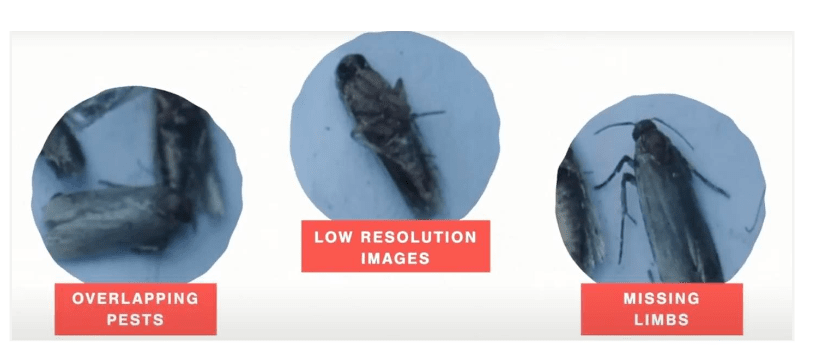
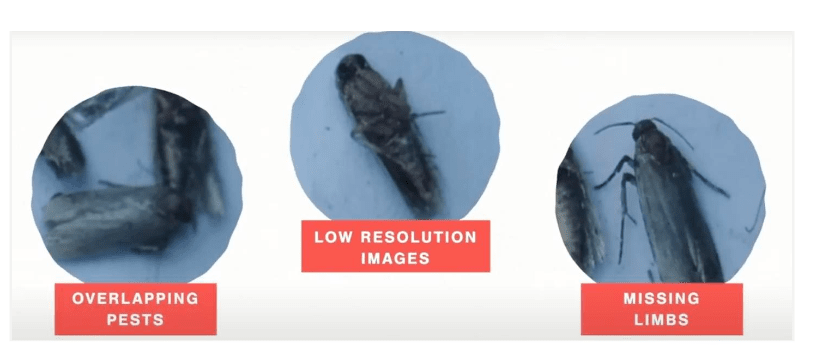
There were plenty of challenges with that. A lot of farmers used phones that only snapped low-resolution photos. Plus, the sheet they used as background might not be white, they might be using the camera-flash, or light wouldn’t be simply good enough. White said there was also an issue about differences in pests across the regions.
The initial data collection started in 2018 in Maharasthra, and last year, the team deployed an early version of the model that was trained and validated with over 28,000 images.
Deployment
Because this app was to be used primarily on low-end phones, researchers had to compress the model from 268MB to 5MB. Then they used PyTorch Mobile to deploy it to an app that also worked offline.
The model now analyzes images sent by farmers and according to rules decided by farming authorities of India. It’s currently deployed in several districts of three Indian states, Gujarat, Maharashtra, and Telangana.
Currently, more than 18,500 farmers are using the application and each village has a lead farmer to converse with the project’s co-ordinators and alert their fellow farmers of notifications sent by the app. Farmers get three levels of alerts: green, yellow, and red; based on that, they used pesticides suggested in the app. You can watch the app in action in the video below.
Next steps
In a summer experiment in Maharashtra, 150 farmers used the system and observed 25% gain in the crop. Because of these results, Maharashtra and Telangana state government has agreed to expand the project into the next cotton growing season (June-November). Along with that, researchers are working with the Better Cotton Initiative (BCI), a global non-profit that looks after the betterment of cotton farmers, scaling this project globally.
Published October 30, 2020 — 10:45 UTC