We’ve been all-in from the get-go. Committed to total transparency about electric vehicles’ climate impact, and our progress towards a sustainable mobility.
When we published our first Polestar 2 Life Cycle Assessment in 2020, including its full methodology, we encouraged other car makers to become more transparent about their products’ climate impact.
Instead, several well-known brands released their own report that attempted to contradict ours. The Astongate scandal, as it became known, now has its own Wikipedia page, where you can read about how their greenwashing campaign quickly fell to pieces.
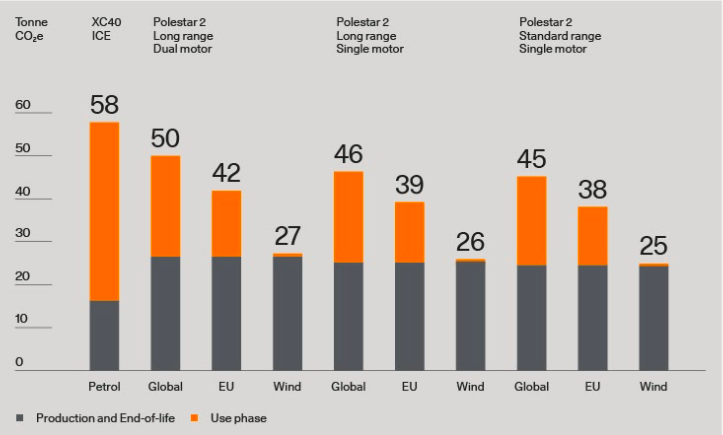
We recently doubled down on our commitment to transparency by releasing our second LCA report. It reveals the climate impact of the two new Polestar 2 versions.
This time we’re not expecting to see a repeat of Astongate. But we can’t help noticing the silence from the rest of the automotive industry.
First came the greenwashing. Now it’s greenhushing.
Greenhushing, the opposite of Greenwashing
You’re probably familiar with the term greenwashing, which describes a deceptive form of marketing that aims to persuade people that an organization’s products, aims and policies are more environmentally friendly than they really are.
Greenhushing is the term used to describe an organization’s deliberate undercommunication about its sustainability practices, in the hope of avoiding scrutiny and criticism.
When companies shy away from talking about the steps they’re taking in the right direction, the result is that consumers and other stakeholders miss the chance to be informed, educated and inspired about real-world progress.
By trying to avoid being seen as not perfect, they show nothing of value. It’s a lose-lose situation. But there is a simple solution.
Companies must take responsibility
Thomas Ingenlath, Polestar CEO, says:
Car makers need to take full responsibility. Every week, we see a new announcement that an automaker is changing direction towards electrification. But going electric alone is not enough. Making cars electric is not the end game, it is a starting point. We need to be honest and transparent.
Both greenwashing and greenhushing destroy people’s trust. And without trust, how can anyone tell whether the ‘sustainable’ product they’re thinking of buying is any more or less sustainable than its competitors?
The answer can only be transparency, because transparency breeds trust.
The journey to sustainability
Of course, we’re not the only brand that’s trying to drive the transition to a sustainable society. More and more companies are taking up the challenge, not only of acting more sustainably, but also talking candidly about their policies, commitments, successes, and failures.
Patagonia is a notable example. Their founder, Yvon Chouinard, takes a refreshingly matter-of-fact approach to sustainability:
Everything man does creates more harm than good. We have to accept that fact and not delude ourselves into thinking something is sustainable. Then you can try to achieve a situation where you’re causing the least amount of harm possible. That’s the spin we put on it. It’s a never-ending summit. You’re just climbing forever. You’ll never get to the top, but it’s the journey.
Music to our ears. For us, the journey to sustainable mobility is exactly that: a journey. We’ve made a good start, but there’s still a long way to go.
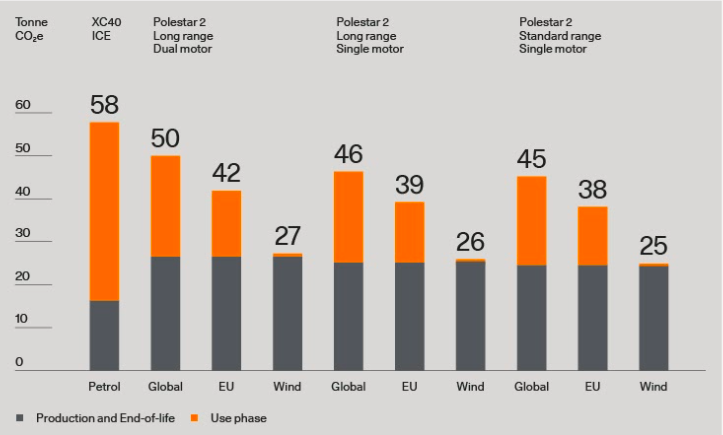
“We are working towards net zero production emissions, but our LCA shows that Polestar 2 is already a climate solution. EV technology provides a car with less than half the carbon impact of an equivalent petrol car if charged with green energy,” says Fredrika Klarén, Head of Sustainability at Polestar.
Transparency helps consumers make informed choices
Our commitment to transparency goes beyond reporting our cars’ carbon footprint. It also covers supply-chain ethics and materials traceability. We’re shining a light on every aspect of our supply and value chain, and documenting our setbacks and challenges, along with our successes.
By telling the whole truth about electric cars’ climate impact, Polestar aims to inspire other carmakers to become more transparent about sustainability.
And by admitting that we’re not perfect, we hope to start winning back people’s trust in the automotive industry as a whole.
Because real change will only happen when consumers start demanding more from companies. And in order to do that, they need to be given the right tools.
No greenwashing. No greenhushing. Just the plain, unvarnished truth.
Polestar and Shift
As we look to the future of personal mobility, sustainability is a critical consideration. That’s why we partnered with The Next Web to bring information about all the exciting changes in the automotive industry together on this page. Accelerating the shift to sustainable mobility by making electric driving a question of when, not if.
Visit the Polestar site to find out more about our approach to sustainability, including details of the four key drivers of sustainable development: climate neutrality, circularity, transparency, and inclusion.