
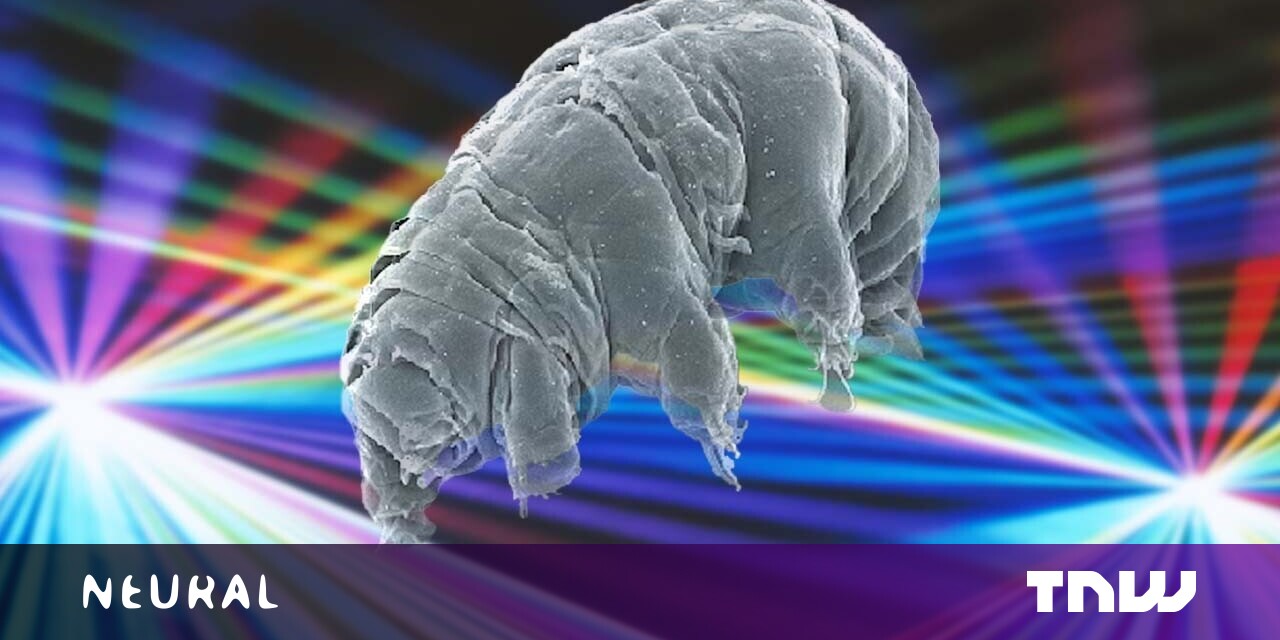
An international team of researchers are claiming to have performed the first ever experiment successfully ‘quantum entangling’ a multi-celled organism.
The team, whose research was recently published in a pre-print paper, says it’s managed to place a tardigrade – a tiny critter affectionately known as a “water bear” – in a state of quantum entanglement between a pair of superconducting qubits.
In other words: the researchers managed to put a tardigrade in a state where it was directly connected to the qubits in such a way that anything that happens to the water bear or the qubits would simultaneously affect all three.
This is a fundamental property of quantum computing. But this kind of quantum function usually only occurs with particle-sized objects. Researchers have put single-celled organisms in a state of quantum entanglement before, but this would mark the first time scientists have done so with a complex biological organism.
Eureka?
There is, however, some debate as to the significance of the team’s efforts. Per the researchers’ paper:
We observe coupling between the animal in cryptobiosis and a superconducting quantum bit and prepare a highly entangled state between this combined system and another qubit. The tardigrade itself is shown to be entangled with the remaining subsystems. The animal is then observed to return to its active form after 420 hours at sub 10 mK temperatures and pressure of 6 × 10⁻⁶ mbar, setting a new record for the conditions that a complex form of life can survive.
There’s a lot to unpack there, but first and foremost: other physicists are being critical of this work early due to what appears to be a loose definition of “entanglement.”
As spotted by Live Science’s Brandon Specktor, the buzz on social media appears to be entirely skeptical:
The qubit is an electrical circuit and putting the tardigrade next to it affects it through the laws of electromagnetism we’ve known about for more than 150 years. Putting a speck of dust next to the qubit would have a similar effect.
11/n
— Ben Brubaker (@benbenbrubaker) December 18, 2021
But, as Specktor also points out, this is all likely to get sorted in peer-review. For now, let’s talk about the experiment itself.
The nightmare before Christmas
Tardigrades are among the most resilient creatures we know of. They can enter a state of suspended animation where they have no observable biological functions in order to survive in extremely hostile environments.
It’s for this reason the scientists chose to attempt integrating them with quantum bits in a circuit. The idea’s pretty basic. You freeze the tardigrades to the point that they’re next to absolute zero, and then you can put them in a state of entanglement just like any other super-cold particle.
However, because the tardigrades are living beings, the story’s a bit more visceral than your standard “we entangled several photons” variety of experiment.
According to team’s paper, these particular tardigrades were “collected in February 2018 from a roof gutter in Niva, Denmark.”
So, to sum up, a group of humans in white coats kidnapped a bunch of cute little water bears, who were already living in a literal gutter, and then exposed them to the coldest temperatures a tardigrade’s ever experienced before forcing them into a three-way entanglement with superconducting qubits.
The team was able to revive one of the tardigrades that were successfully involved in what they’re calling entanglement. But, as for the others, the researchers wrote “we wish to point out that it is very important for the revival of the animal to change the external temperature and pressure gently.”
Rest in power little science bears, we’ll never forget you.
Further reading: Physicists might have created quantum entanglement in bacteria